
Apollo as God of Medicine, Prophecy, and Music
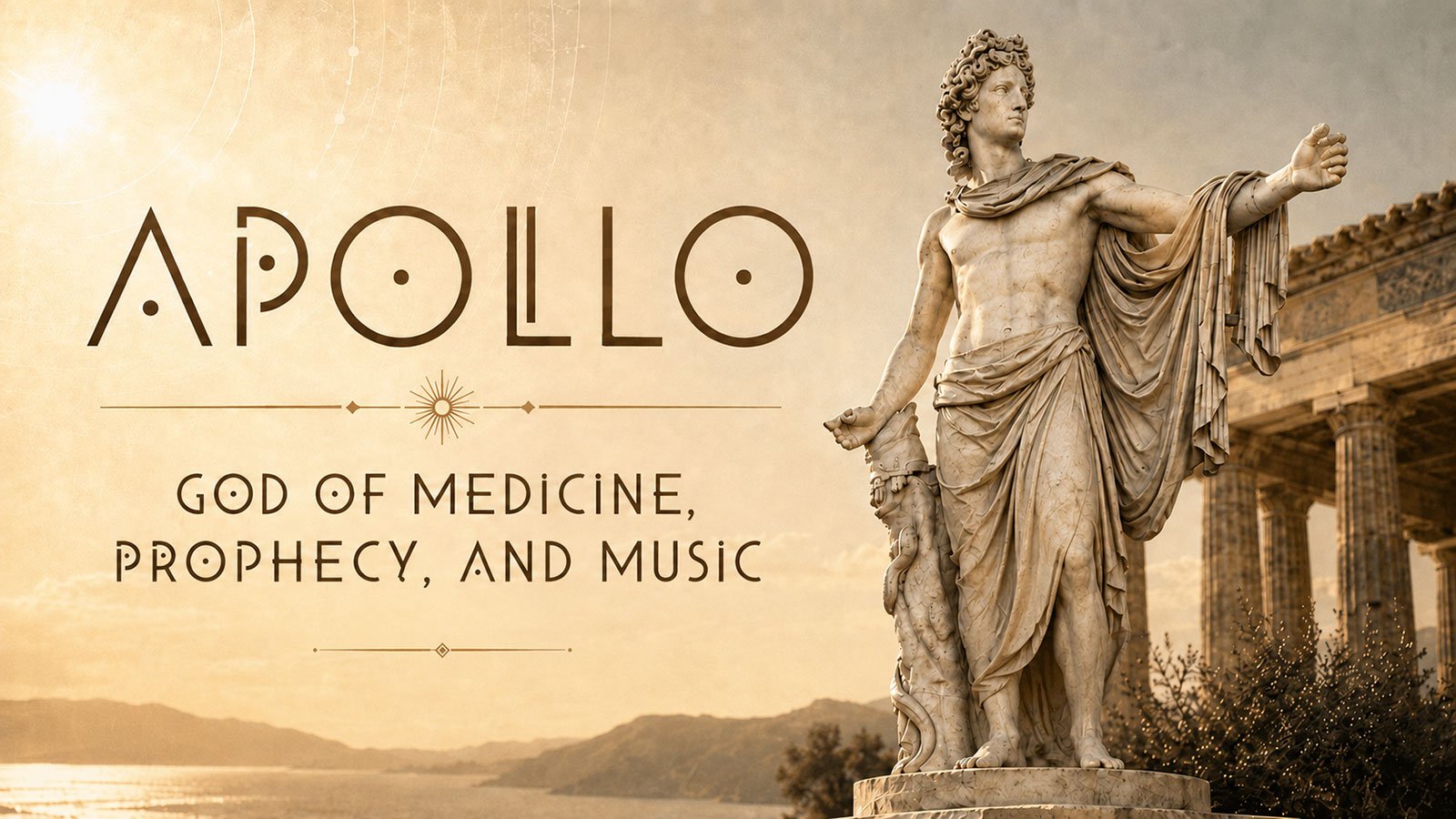
Where Clarity Meets Mystery
Few figures in the Greek pantheon carry as wide a reach as Apollo. He is the god of the sun and of music, of healing and of plague, of prophecy and of poetry, of archery and of reason. At first glance, this range might look like mythological sprawl — too many domains crowded under one name. But sit with it a while, and a pattern emerges. Apollo governs the places where clarity meets mystery: the moment a fever breaks, the note that resolves a dissonant chord, the oracle's cryptic answer that somehow makes sense only in hindsight. He is the god who presides over transformation through insight, whether that insight arrives through the body, the ear, or the unconscious mind.
For a practice built on sound, touch, breath, and stillness, Apollo is a natural figure to sit with. His myths aren't just old stories — they're a way of thinking about healing that predates, and quietly underlies, much of what integrative work still reaches for today.
Born of Light, Bound to Delphi
Apollo was the son of Zeus and the Titaness Leto, born on the floating island of Delos alongside his twin sister Artemis. According to the myths, his birth itself was a kind of ordeal — Leto wandered in search of a place to give birth, refused shelter by lands fearful of Hera's jealousy, until Delos alone welcomed her. From nearly his first breath, Apollo's story is one of arrival against resistance, of light finding a place to land.
Soon after his birth, Apollo made his way to Delphi, where he slew the serpent Python guarding the sacred site, and claimed the location as his own. Delphi would become the most important oracle in the ancient world, home to the Pythia — the priestess who, in a trance state, spoke Apollo's prophecies to those who sought his counsel. Kings, generals, and ordinary citizens alike traveled great distances to ask Delphi's oracle for guidance, and the answers they received were rarely simple. They came wrapped in metaphor, riddle, and layered meaning — truths that required real reflection to unlock rather than instructions to be followed at face value.
This is worth pausing on. Apollo's wisdom was never handed over plainly. It asked something of the listener. That, too, feels familiar to anyone who has sat with a meditation practice or a somatic process and found that the insight arrives sideways, not head-on — through the body's own timing rather than the mind's demand for a quick answer.
The God Who Both Wounds and Heals
Apollo's relationship to medicine is layered in a way that modern retellings sometimes flatten. He wasn't simply a benevolent healing god. In the Iliad, it is Apollo who sends plague arrows into the Greek camp, punishing Agamemnon for dishonoring his priest. The same god capable of restoring health could withhold it, or take it away entirely. Ancient audiences didn't find this contradictory. Apollo held both the wound and the cure because, in their understanding, healing power and the power to cause harm were never fully separable. Whatever can restore balance can also disrupt it — the same sun that gives life can scorch the field.
This duality carried forward into how Apollo was worshipped as a god of medicine. His altars weren't only sites of petition for cures; they were also sites of appeasement, ways of staying in right relationship with a force that could go either way depending on how it was approached. There's something honest in that framing that still resonates: the body's own capacity for repair is not separate from its capacity for breakdown. They share the same root system.
It was through this medical lineage that Apollo fathered Asclepius, whose own legend — raised by the centaur Chiron and skilled enough in the healing arts to raise the dead — would eventually eclipse his father's role as the more direct patron of physicians and healing temples. Asclepius carried medicine forward as its own dedicated tradition, but the current running through it traced back to Apollo, the god who first held both sickness and its remedy in the same hand.
Music as Medicine
Apollo's other defining domain was music. He was closely associated with the lyre, an instrument said to have been given to him by Hermes, and he presided over the Muses, the nine goddesses of artistic and intellectual inspiration. Greek thought didn't separate music from healing the way modern categories often do. Sound was understood to have direct effects on mood, on the nervous system, on the soul's alignment — music could calm frenzy, incite passion, or restore a person to equilibrium depending on the mode and rhythm used.
This is perhaps the most quietly relevant thread for anyone working with sound as a healing modality today. Long before frequency and resonance were discussed in clinical or scientific terms, Apollo represented the intuitive understanding that vibration moves something in us that words alone cannot reach. The lyre wasn't decoration to Greek religious life — it was considered an instrument capable of ordering chaos into harmony, which is very close to how sound healing is still described by those who practice it.
Apollo and the Value of Measured Insight
If there's a single thread tying together Apollo's oracle, his medicine, and his music, it may be this: Apollo represents insight that requires patience. The Pythia's prophecies had to be interpreted. A body's healing has its own timeline that cannot be rushed by will alone. Music unfolds across time — a single note tells you little, but the whole piece, given room to move, can shift something in the listener that force never could.
The famous inscription at Delphi, "Know Thyself," carved at the entrance to Apollo's temple, captures this whole orientation in two words. Not "control thyself," not "fix thyself" — know. Apollo's domain was never about domination over illness, fate, or dissonance. It was about clarity earned through attention, patience, and right relationship with forces larger than the self.
Carrying Apollo's Thread Forward
Apollo's myths ask us to hold complexity rather than resolve it too quickly — to recognize that healing and harm, clarity and mystery, sound and silence are often working from the same source rather than opposing ones. That's a useful frame for any practice rooted in the body's own intelligence, whether through the resonance of a sound bath, the patience of a meditation sit, or the trust required in hands-on therapeutic work.
His son Asclepius would go on to become the more familiar face of ancient medicine, with temples built specifically for healing and dream incubation. But it's worth remembering that the current started earlier and ran deeper — with a god who understood that the plague and the cure, the riddle and its answer, the discord and its resolution, were never really separate things to begin with. They were simply two points on the same continuum, waiting for enough patience and attention to move from one to the other.