
Asclepius, God of Healing and the Temples of Dream
Where Medicine Became Sacred
By the time Asclepius enters the story, healing has already been touched by the divine. His father Apollo held medicine alongside prophecy and music, one thread among several. But Asclepius narrowed that inheritance into a single, devoted purpose. He is the god the Greeks turned to specifically for the body's restoration — and unlike his father, whose healing power always carried the shadow of harm, Asclepius came to represent something closer to healing alone. Where Apollo held the wound and the cure in the same hand, Asclepius became the hand extended in cure only.
That distinction mattered enormously to the ancient world. It's why, centuries later, physicians still swear an oath in his name, and why his symbol — a single serpent coiled around a staff — remains one of the most recognized emblems of medicine to this day.
Born Between Worlds
Asclepius's origin story is, fittingly, a story about crossing a threshold between life and death before he ever practiced healing himself. His mother, Coronis, was a mortal woman loved by Apollo. According to the most widely told version of the myth, Coronis was unfaithful to Apollo while pregnant, and the god, learning of it through a message carried by a raven, struck her down in anger. As Coronis lay on her funeral pyre, Apollo's grief overtook his fury — he could not save her life, but he cut the unborn child from her body and carried him to safety. That child was Asclepius, born from a mother already lost, delivered into life through his father's second thoughts and steady hands.
Apollo entrusted the infant to Chiron, the wise centaur who tutored many of Greek mythology's great figures. Under Chiron's guidance, Asclepius learned the foundational art of medicine so completely that he surpassed his teacher. He didn't merely treat illness — the myths say he learned to restore the dead to life, using the blood of the Gorgon Medusa, gifted to him by Athena, which held the power to kill or resurrect depending on which vein it was drawn from.
This gift proved to be his undoing. Zeus, alarmed that mortals were escaping death entirely and that the natural order was being upended, struck Asclepius down with a thunderbolt. It's a telling detail: Asclepius wasn't punished for causing harm, but for healing too completely, for closing the gap between mortal and divine a little too far. Even in myth, healing had a boundary it wasn't meant to cross.
The Serpent and the Staff
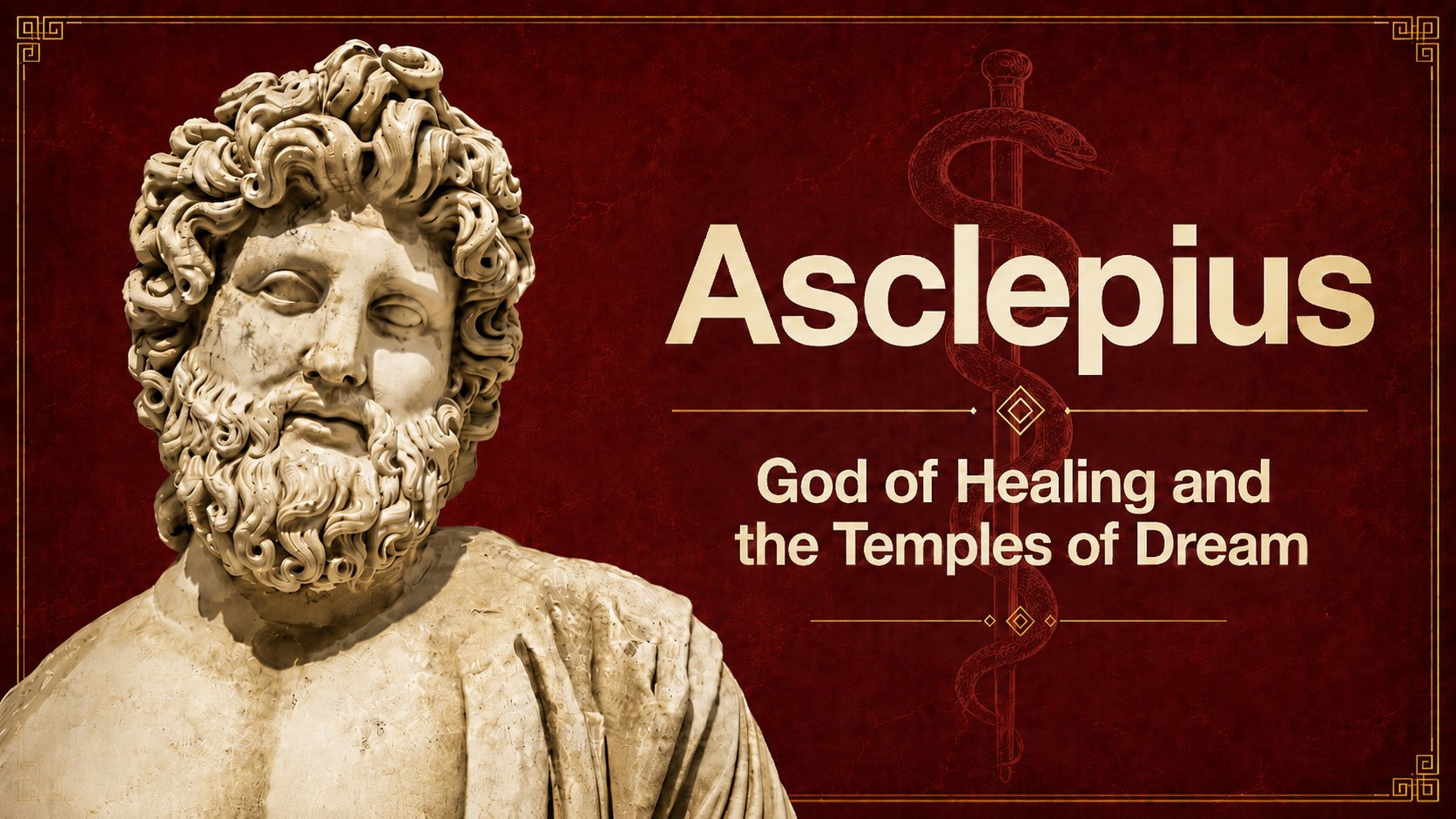
Asclepius is almost always depicted holding a staff with a single serpent wound around it — the Rod of Asclepius, still used today as a symbol of medicine, distinct from the two-serpent caduceus often mistaken for it. Serpents held a particular meaning for the Greeks: their ability to shed their skin made them a living symbol of renewal, of the body casting off what no longer serves it and emerging changed. Some accounts describe a serpent whispering secrets of healing herbs into Asclepius's ear, tying the symbol directly to the practical knowledge of remedies alongside its more mystical meaning.
Serpents were also kept, quite literally, in the temples built in his honor — non-venomous snakes moved freely through the sanctuaries, and their presence near a sleeping patient was considered a sign of the god's own nearness.
The Asclepieia
As Asclepius's cult spread across the Greek world, temples dedicated to him — known as Asclepieia — became something between a hospital, a spa, and a sanctuary. The most famous, at Epidaurus, drew pilgrims from across the ancient Mediterranean. These weren't simple shrines. They often included dormitories, bathhouses, theaters, and stadiums, reflecting a belief that healing involved the whole person — body, mind, and spirit together — rather than treating a single ailment in isolation. Rest, community, and even entertainment were considered part of the therapeutic setting, not distractions from it.
At the center of the Asclepieia was a practice that made them unlike any other healing site in the ancient world: incubation, or enkoimesis — the ritual act of sleeping within the temple grounds in hopes that Asclepius himself would appear in a dream, offering a diagnosis, a remedy, or sometimes healing outright while the patient slept. Pilgrims underwent preparatory rites of purification before lying down in a special chamber called the abaton, waiting for the god to visit them in the space between waking and sleep. What happened in that chamber, and how those dreams were interpreted and acted upon, is really its own story — one substantial enough to deserve its own dedicated telling rather than a summary tucked into this one.
The Orphic Hymn to Asclepius
Asclepius's devotion wasn't confined to temple ritual. Among the collection of ancient devotional poems known as the Orphic Hymns — verses used in mystery cult worship, likely composed sometime in the early centuries CE though rooted in older Orphic tradition — is a hymn addressed directly to him. It calls on Asclepius as a gentle, life-giving presence, a soother of every kind of suffering, and asks for his protection against disease and premature death.
What stands out in the hymn is its tone. Asclepius isn't invoked with fear, the way a god of plague or fate might be. He's addressed with warmth, almost tenderness — a healer approached the way one might approach a trusted physician rather than a distant, unpredictable power. It reflects how thoroughly Asclepius had come to represent healing stripped of its harsher edges, a god defined almost entirely by comfort rather than consequence.
The hymn itself, in Thomas Taylor's 1792 English translation, reads:
Great Asklepios, skilled to heal mankind,
All-ruling Paian, and physician kind;
Whose arts medicinal can alone assuage
Diseases dire, and stop their dreadful rage.
Strong, lenient God, regard my suppliant prayer,
Bring gentle health, adorned with lovely hair;
Convey the means of mitigating pain,
And raging deadly pestilence restrain.
O power all-flourishing, abundant, bright,
Apollon's honoured offspring, God of light;
Husband of blameless Hygeia, Health,
The constant foe of dread disease, the minister of woe:
Come, blessed saviour, human health defend,
And to the mortal life afford a prosperous end.Orphic Hymn 66, "To Asklepios" (titled "To Esculapius" in Taylor's own edition), trans. Thomas Taylor (1792), lightly modernized in spelling. Full text via Theoi Classical Texts Library.
Notice how the hymn addresses him twice as a physical, felt presence — "gentle health, adorned with lovely hair" — before ever asking for anything. Reverence comes first. The request comes only after. It's a small structural choice, but it says something about how the ancient worshipper approached healing: not as a transaction, but as a relationship built on trust already given.
A Story Still Unfolding
Asclepius closes a particular arc that began with reincarnation, moved through the elemental logic of Greek medicine, and passed through Apollo's wider domain of prophecy, music, and healing held together. With Asclepius, healing becomes fully its own devoted practice — embodied, ritualized, and, notably, deeply connected to the dreaming mind as a source of guidance rather than just the waking body.
That connection between sleep, dream, and healing is one of the more striking threads in ancient practice, and one that resonates with anything rooted in stillness, receptivity, and the body's own intelligence working beneath conscious control. The Asclepieia understood something worth sitting with: that healing doesn't always arrive through direct intervention. Sometimes it arrives while we're not trying to force it at all — in rest, in surrender, in the quiet hours when the mind lets go of its grip.
The practice of incubation itself — what pilgrims actually did inside those temple walls, and what their dreams were believed to reveal — deserves its own fuller exploration. For now, it's enough to know that Asclepius offered the ancient world something rare: a god who asked for trust, and answered with rest.