
The Soul's Long Journey Through Ancient Philosophy
When most of us think of reincarnation, our minds travel east — to the wheel of samsara in Hindu and Buddhist thought. But long before those ideas reached Western ears, a quieter, stranger version of the same conviction was taking root on Greek soil. The philosophers we now credit with founding logic, mathematics, and Western rationalism were, many of them, also deeply convinced that the soul does not end with the body. It travels. It returns. It remembers, if we let it.
This is the story of reincarnation according to the Greeks — a thread of belief that runs from mystery cults through Pythagoras and into the heart of Plato's philosophy, shaping how an entire civilization thought about death, memory, and the nature of the self.
The Orphic Roots of a Soul in Exile
To find the earliest Greek seeds of reincarnation, we have to look past the familiar Olympian myths and into the Orphic tradition — a mystery religion attributed to the mythic poet-musician Orpheus, who famously descended into the underworld to retrieve his beloved Eurydice.
Orphism held a startling idea for its time: the human soul is divine in origin, but fallen. According to Orphic myth, humanity was formed from the ashes of the Titans, who had devoured the infant god Dionysus. Because the Titans had consumed something sacred, human beings carry within them a spark of the divine — trapped, however, inside a body understood as a kind of tomb or prison. The Greek phrase soma sema, "the body is a tomb," captures this beautifully and painfully at once.
For the Orphics, life was not a single act but part of a longer sentence. The soul would be born, live, die, and be born again, cycling through bodies — sometimes human, sometimes animal — until it had purified itself enough of Titanic guilt to be released back into the divine realm from which it came. Initiation rites, ethical purity, and remembering one's true origin were all seen as ways to shorten this cycle.
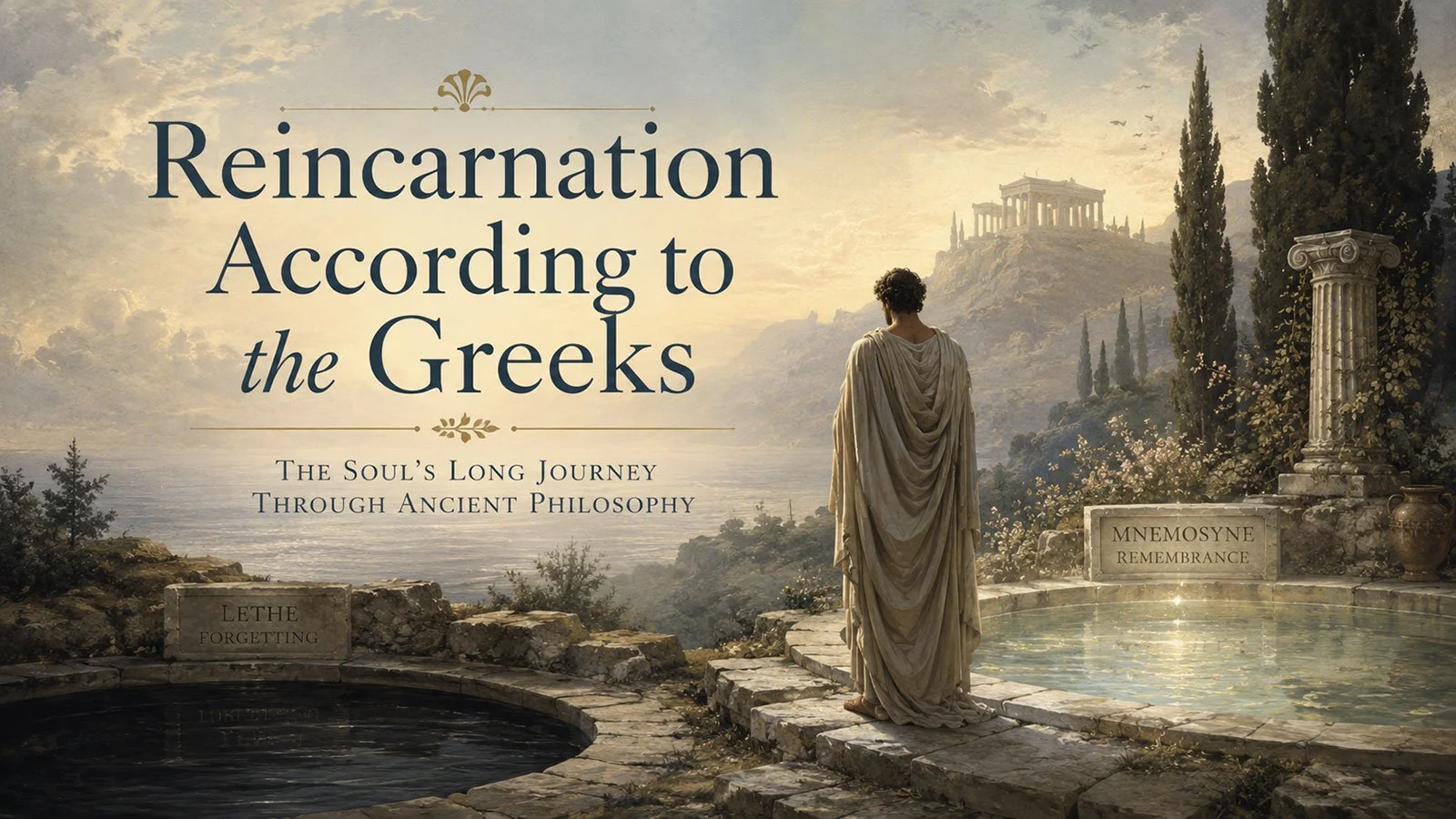
Memory, in fact, sat at the very center of this belief — and here two figures from Greek myth become essential: Mnemosyne, the Titaness of memory and mother of the nine Muses, and the River Lethe, whose name means "forgetting" and whose waters were said to flow through the underworld.
Archaeologists have recovered small inscribed gold tablets, buried with Orphic initiates, that read almost like instructions for the afterlife. The soul, upon death, is warned not to drink from the spring of Lethe, which would erase all memory of its former life and divine origin. Instead, it is directed toward a second spring — guarded, in some versions, by attendants of Mnemosyne herself — and instructed to declare its heavenly lineage in order to drink from that water instead, the water of remembrance. To drink from Lethe was to be born again into forgetfulness, doomed to repeat the same errors without knowing why. To drink from Mnemosyne's spring was to carry wisdom and identity forward, life after life, edging closer to liberation. In this sense, the earliest Greek reincarnation stories weren't abstract philosophy at all — they were deeply personal, almost devotional, concerned with liberation as much as with belief, and centered on a single, urgent question: will the soul remember, or will it forget?
Pythagoras and the Doctrine of Metempsychosis
It was Pythagoras, in the sixth century BCE, who took these mystery-cult intuitions and shaped them into something resembling formal doctrine. The term most associated with Greek reincarnation, metempsychosis, literally means "the changing of the soul" — the transmigration of a soul from one body into another after death.
Pythagoras taught that the soul is immortal and passes through a sequence of incarnations, not necessarily limited to human form. Ancient sources report — with a mix of reverence and amusement — that Pythagoras claimed to remember his own previous lives, including one as a Trojan warrior named Euphorbus. He is even said to have recognized a shield from that former life hanging in a temple, and to have once stopped a man from beating a dog because he recognized, in its yelp, the voice of a departed friend.
Whether or not we take these anecdotes literally, they reveal something important: for Pythagoras and his followers, reincarnation wasn't a poetic metaphor. It was lived reality, with ethical consequences. If a beloved teacher might return as an animal, then how one treats all living beings takes on new moral weight. This is part of why Pythagoreans famously practiced vegetarianism — an early Western example of compassion extended across the boundary of species because of a belief in shared, cycling soul-stuff.
Plato on Reincarnation as Philosophy
If Pythagoras planted the seed, Plato gave Greek reincarnation its most enduring philosophical form. Across several dialogues, Plato treats the soul's rebirth not as folklore but as a serious metaphysical claim, woven into his broader vision of reality.
In the Phaedo, written as an account of Socrates' final hours before his execution, Socrates argues calmly that death is nothing to fear, because the soul is immortal and simply moves on to another existence. He reasons that opposites come from opposites — life from death, death from life — suggesting a natural cycling between states of being.
In the Meno, Plato introduces the striking idea of anamnesis, or recollection. Learning, he argues, is not the acquisition of something new but the remembering of truths the soul already knew before birth, in a previous state of existence. He demonstrates this through a scene where an uneducated slave boy, guided only by careful questioning, arrives at a geometric truth he was never taught — evidence, Plato suggests, that the knowledge was already within him, waiting to resurface.
It's worth pausing on how closely this echoes the older Orphic imagery of Mnemosyne and Lethe. Where the gold tablets pictured memory and forgetting as literal waters to be chosen at the threshold of death, Plato transforms the same intuition into a philosophical method. For him, every soul has, at some point, glimpsed eternal truths directly. Birth itself becomes a kind of crossing through Lethe, clouding that knowledge in forgetfulness — and philosophy becomes the disciplined work of recollection, of coaxing the soul back toward what it once knew clearly. Learning, in other words, is Plato's version of drinking from Mnemosyne's spring.
Perhaps most vividly, in the Republic, Plato closes his great work on justice with the Myth of Er — a soldier who dies in battle, glimpses the afterlife, and returns to tell of souls choosing their next lives based on the lessons and errors of the one just completed. Before returning to earth, Plato tells us, each soul crosses the scorching Plain of Forgetfulness and camps beside the River of Unmindfulness — his own rendering of the Lethe — and is required to drink a measured portion of its water. Drink too much, and the soul forgets everything of its former life and choices; the wisest souls, Er reports, learn to drink sparingly, carrying forward just enough memory to guide them well. Souls who lived poorly often choose poorly again, blinded by unresolved patterns; souls who cultivated wisdom in life choose more wisely the next time around. It's a strikingly modern image — reincarnation not as punishment handed down from above, but as a mirror of our own unfinished growth, chosen again and again until we get it right.
Empedocles and the Wandering Daimon
Alongside Pythagoras and Plato stands Empedocles, a philosopher-mystic who described himself, in surviving fragments of his poetry, as a daimon — a divine spirit exiled from the company of the gods and condemned to wander through thousands of years of birth in the forms of plants, animals, birds, and fish because of some ancient transgression. His words carry an aching, personal quality rare in philosophical writing: a being who remembers, however dimly, a more luminous origin, and longs to return to it.
Why This Still Matters
What strikes me most about the Greek understanding of reincarnation is how inseparable it was from memory, ethics, and self-knowledge. This wasn't rebirth as spectacle or curiosity — it was a framework for taking one's life seriously, for treating remembrance and inner purification as the real work of being human. Plato's Myth of Er, in particular, offers something many of us find quietly comforting: the idea that our struggles are not random, but part of a longer unfolding, and that awareness itself — really seeing our patterns, choosing to drink from memory rather than forgetting — is what allows us to live differently next time.
You don't have to accept metempsychosis as literal fact to find something valuable here. The Greeks remind us that questions about who we were, who we are becoming, and what it means to live wisely have occupied thoughtful people across every culture and every age. Whether through Pythagorean memory, Platonic recollection, or the practices we explore today in past life regression and contemplative work, the invitation is the same: to look honestly at the soul's long journey, and to meet it with curiosity rather than fear.