
Past Life Regression — What It Is, and Why So Many Are Curious to Explore It
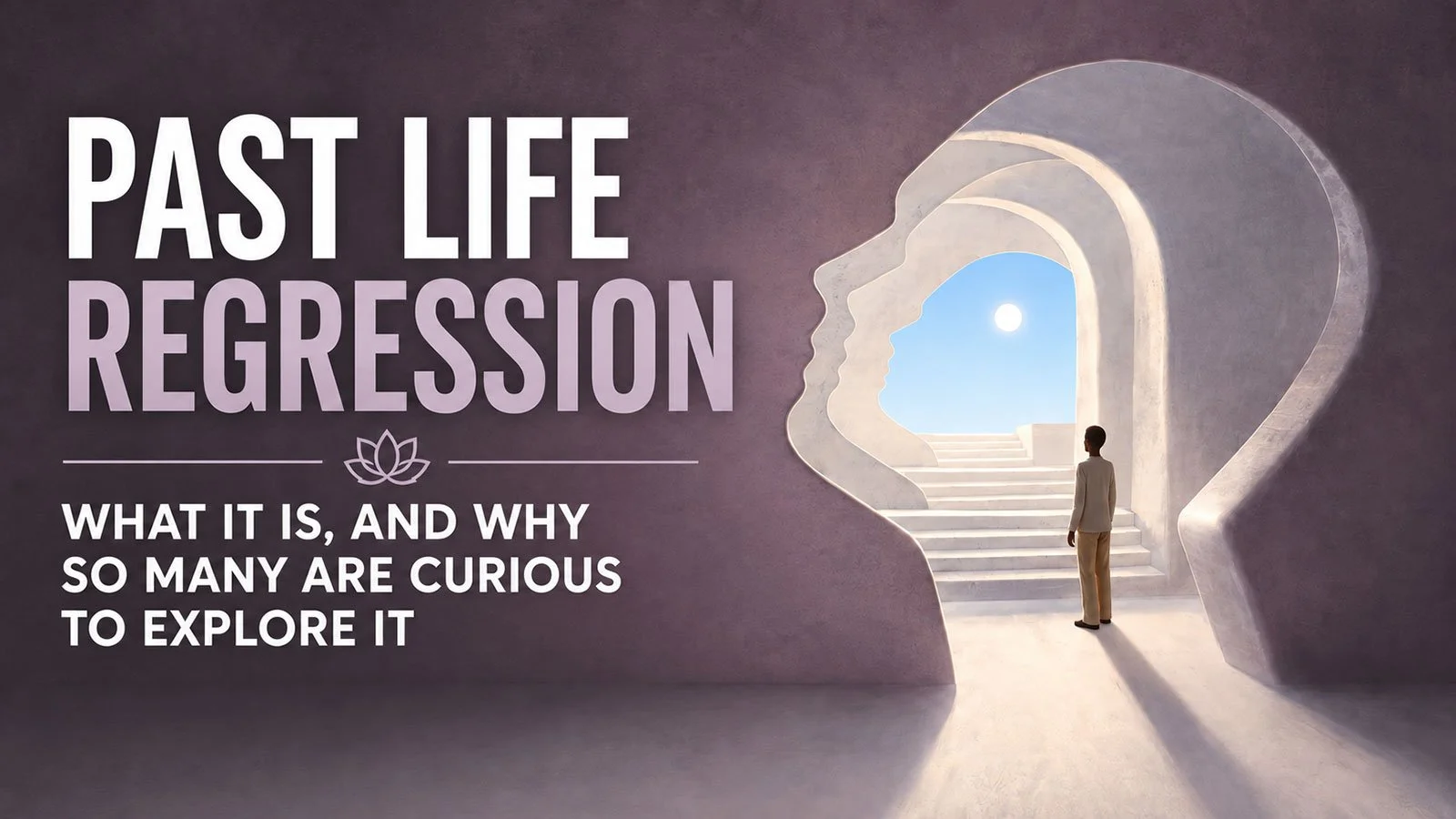
The Pull of Something Older
There's a particular kind of curiosity that seems to visit almost everyone at some point. Maybe it comes in the form of a recurring dream, an inexplicable pull toward a place you've never been, or an intense connection to a person that feels older than the time you've actually known them. Maybe it's a fear you can't quite trace to anything in this lifetime, or a skill that seemed to arrive fully formed. For many people, these moments raise a quiet question: could I have lived before?
Past life regression is one of the oldest and most gently explored answers to that question. It's a therapeutic practice that uses relaxation and guided hypnosis to help a person access memories that may originate from a life lived before this one — memories that, whether understood literally or symbolically, often carry real emotional weight and real potential for healing in the present.
What Actually Happens in a Session
A past life regression session looks much less dramatic than popular culture might suggest. There's no swinging pocket watch, no dramatic collapse into a trance. Instead, a trained practitioner guides you into a state of deep physical relaxation, similar to the drowsy, focused calm you might feel in the last few minutes before sleep. In this state, your conscious mind softens its grip, and the subconscious — where memory, emotion, and pattern live — becomes more accessible.
From there, the practitioner offers gentle prompts, inviting you to notice images, sensations, or feelings that arise. Some people see vivid scenes: a place, a face, a moment of conflict or tenderness. Others experience something more like a felt sense — an emotion, a posture in the body, a phrase that surfaces without context. There is no single "correct" way to experience a regression, and a skilled facilitator will meet you wherever you land, without forcing the process toward drama or spectacle.
Throughout, you remain aware and in control. This isn't something that happens to you; it's a collaborative exploration, and you can pause, ask questions, or step back at any point.
A Practice with Deep Roots — and a Modern Bridge
The idea that the soul might carry experience across multiple lifetimes is far from new. Threads of it appear in Hindu and Buddhist teachings on reincarnation, in some interpretations of Kabbalistic thought, and in the cosmologies of many Indigenous traditions around the world. Long before regression therapy existed as a clinical practice, cultures were already asking what continues when a body does not.
What changed in the modern era was the arrival of a clinical bridge between this ancient idea and contemporary psychiatry. In the 1980s, a Yale-trained psychiatrist named Brian Weiss, MD, was treating a patient for anxiety using standard hypnotherapy — a technique he'd used many times before for straightforward, evidence-based purposes. What happened next surprised him. Under hypnosis, his patient began describing detailed experiences from what appeared to be a previous life, and in the sessions that followed, her long-standing symptoms began to resolve in ways that years of conventional treatment had not achieved.
Weiss was, by his own account, a skeptical scientist. He hadn't set out to explore past lives, and the experience reportedly unsettled his own understanding of what psychiatry could explain. But rather than dismiss what he witnessed, he documented it carefully, and he went on to work with many more patients using similar techniques, eventually sharing his findings in ways that introduced past life regression to a much broader audience. His work helped move the practice out of the exclusive domain of mystics and into a conversation that clinicians, therapists, and everyday people curious about their own healing could take seriously.
You don't have to adopt any particular metaphysical belief to appreciate what Weiss's work highlighted: that the subconscious mind is capable of generating deeply meaningful material in a regressed state, and that working with that material — whatever its ultimate origin — can produce genuine emotional relief.
Why People Seek It Out
People arrive at past life regression from many different doors. Some come with a specific, nagging pattern they can't resolve through conventional means alone: an irrational fear of water, a recurring relationship dynamic, an ache of grief that doesn't seem to belong to anything in this life. Others come from a place of pure spiritual curiosity, wanting to understand their soul's journey more fully. Still others are drawn in after a single strange, unbidden moment — déjà vu so strong it stopped them in their tracks — and they simply want to explore it further.
Common reasons people seek out this work include:
Unexplained fears or phobias that don't trace back to any experience in this lifetime
Recurring dreams or visions involving unfamiliar times, places, or people
Patterns in relationships that feel repetitive or karmic in nature
Physical or emotional symptoms with no clear medical or psychological origin
A desire for deeper self-understanding, spiritual growth, or a sense of life purpose
Grief or loss that regression work can help contextualize and soften
Regardless of the door someone walks through, the work tends to circle back to the same core purpose: understanding the roots of a present-day pattern so that it can finally loosen its grip.
Healing in the Present, Regardless of Belief
One of the most freeing aspects of past life regression is that it doesn't require a fixed belief system to be valuable. You don't need to arrive as a devout believer in reincarnation, and you don't need to leave as one either. Many practitioners — and many of the people they work with — hold the experience with an open, exploratory posture: whether these are literal memories of previous lives, symbolic stories generated by the subconscious, or some blend of both, the emotional insight and relief that often follow are real and worth honoring.
This is very much in keeping with an integrative approach to healing. The body, mind, and soul are deeply interconnected, and sometimes the most direct path to easing a present-day struggle isn't found by staying only in the present. Sometimes it's found by widening the lens — by making space for the possibility that our stories are longer than we remember, and that healing can reach backward as readily as it moves forward.
Approaching the Work with Openness and Care
If you feel drawn to explore past life regression, the most important ingredient is a sense of safety. This work asks you to soften your usual defenses and let unfamiliar material surface, so it matters a great deal that you feel grounded, respected, and gently guided by someone experienced in holding that space. A good session never feels like a performance or a test — it feels like an invitation.
Whatever you discover — a vivid scene from another era, a felt sense with no clear picture, or simply a deeper stillness — the goal is the same: to meet whatever arises with curiosity rather than judgment, and to let that material do its quiet work of healing.
Our own lives are often layered with more history, more meaning, and more resilience than we realize in any given moment. Past life regression offers one gentle path toward uncovering that fuller story — and toward finally making peace with the parts of it that have been asking, quietly, to be understood.