
Marma Points and the Places Where Life Gathers
A surgeon's chapter, not a wellness text
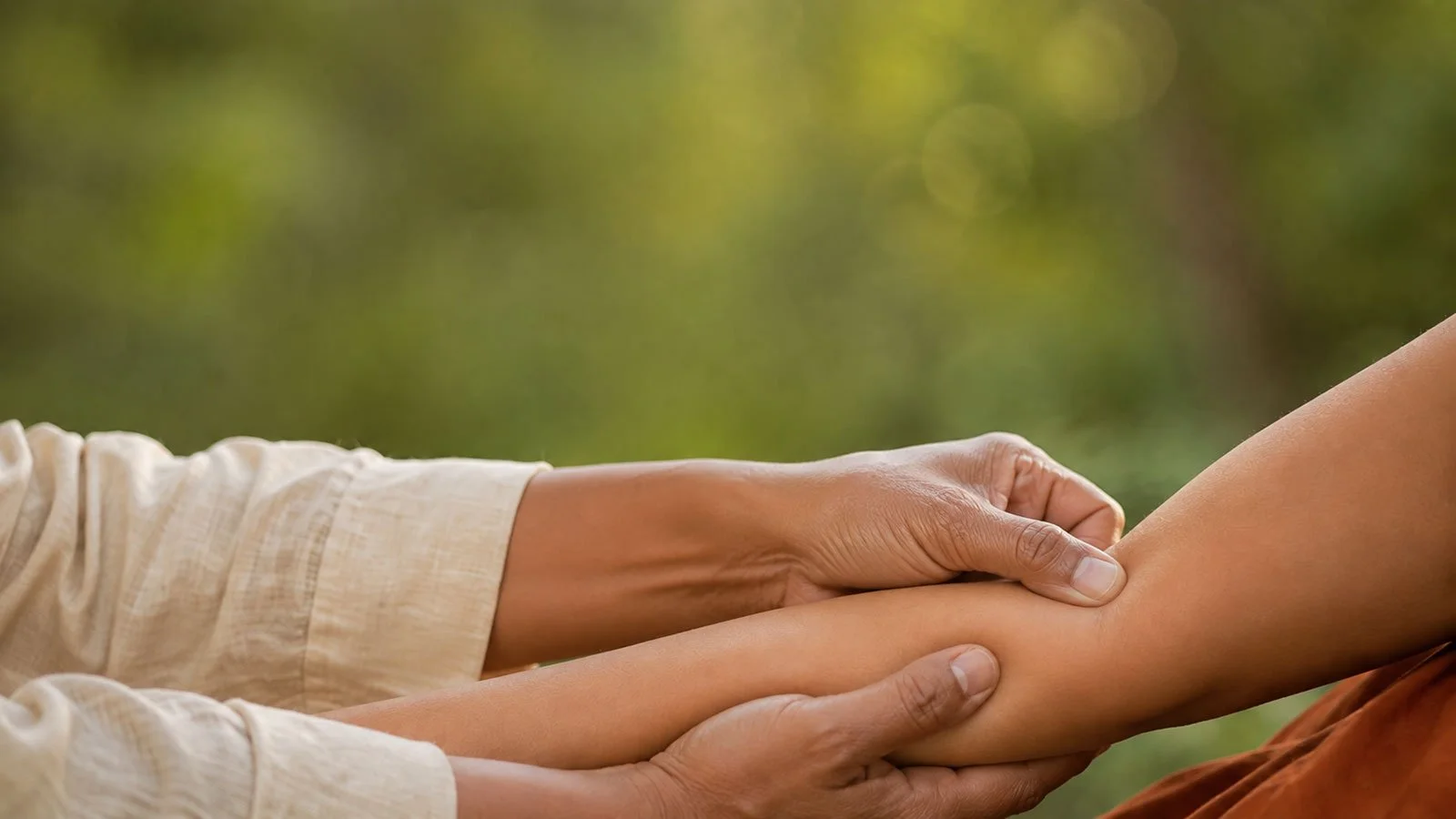
There is a moment in hands-on work that most practitioners recognize before they have language for it. You are moving through tissue without any particular agenda, and your hands arrive somewhere that feels different — denser, more organized, more consequential than the ground around it. Something gathers there, and you slow down without having decided to. Sanskrit has a word for those places, and it is older and less gentle than the way we tend to use it now.
The word is marma, and it comes from the root mṛ, to die. Dalhana, the twelfth-century commentator on Sushruta, glosses it in a phrase that leaves little room for softening — they cause death, and that is why they are called marma.1
Sushruta gives these points an entire chapter of the Sharirasthana, opening it by attributing the teaching to Dhanvantari, the physician-god at the head of the surgical lineage.2 His definition is structural rather than mystical. A marma is the site where five things converge — mamsa (muscle), sira (vessels), snayu (ligaments and tendons), asthi (bone), and sandhi (joints). Where those five meet, you have a marma. Where they do not, you do not.
He counts one hundred and seven, then classifies them three separate ways. By dominant structure — eleven muscle marmas, forty-one vessel marmas, twenty-seven ligament marmas, eight bone marmas, twenty joint marmas. By region — eleven in each limb, twelve across the chest and abdomen, fourteen in the back, thirty-seven from the collarbone up.3
And then, most tellingly, by what happens when they are injured. Some kill immediately. Some kill slowly, over days or weeks. Some kill when an embedded weapon is withdrawn. Some maim. Some leave lasting pain.
The immediately fatal class holds nothing obscure. It runs to nineteen points gathered under eight names — the heart, the bladder, the navel, the rectum, the crown of the head, the temples, the great vessels of the throat, and the four vessel confluences serving the nose, ears, eyes, and tongue.4 A trauma clinician working from an entirely different anatomy, in an entirely different century, flags most of that same territory. Two traditions arriving at one list by separate roads is the kind of convergence worth pausing on.
That last classification tells you what the chapter is for. It is a surgeon's guide to where not to put the blade, and a field manual for reading the severity of a wound. Sushruta says as much directly, calling knowledge of the marmas half the subject of surgery. It is worth sitting with how far that is from the gentle-activation framing most of us met first.
Where the life force stays
And yet the chapter is not purely anatomical, which is where the story gets more interesting. Sushruta writes that even when the limbs are severed entirely, if the marmas themselves are unstruck, the vital principle remains — soma, marut, tejas, the three gunas, and the embodied self continue to abide in those places.5
So prana is genuinely present in the classical account. The marmas are seats where life concentrates, and that is precisely why injuring them is catastrophic. A modern reader arriving here after some yoga study will feel an immediate click of recognition — these must be nodes on the nadi network.
They are not, at least not in this text. The prana Sushruta invokes is prana in the physiological sense of Ayurveda, the vital principle whose disruption ends a life. He does not route it through ida, pingala, or sushumna. He does not mention chakras anywhere. The subtle-body architecture most of us now associate with these points had not been written when this chapter was composed, and would not be fully articulated for something like a thousand years.
It is also worth noting that Sushruta's map is not the only classical one. Charaka, working in the internal-medicine tradition rather than the surgical one, treats just three marmas as decisive — the head, the heart, and the bladder — and devotes chapters to them under the heading of the trimarma.6 Even within the classical corpus, the number and the emphasis shift depending on what the physician is trying to do.
The word that causes the trouble
Most of the modern conflation comes down to a single term. Sira.
Sushruta counts seven hundred siras in the body, and elsewhere in the Sharirasthana he carefully distinguishes sira, dhamani, and srotas as three related but separate categories of vessel.7 Forty-one of the 107 marmas are sira marmas, the largest single class.
In a great deal of contemporary writing, sira is rendered as "nadi," and the whole marma system quietly becomes a subtle-energy grid. Textually, that is a substitution rather than a translation. The channels of Ayurveda carry substances — food, water, the tissues, the wastes — and exist to explain and treat disease. The nadis of yoga carry prana, and exist to describe the movement of energy toward liberation. Different cargo, different purpose, different literature. Collapsing them makes the correspondence look tidier than it is, and in this material tidiness is usually a warning sign.
Three streams, not one river
None of which means the energetic reading of marma was invented out of nothing. It comes from real traditions. Just not from Sushruta.
The most substantial is varmam, the Tamil Siddha art of vital points, also called Varma Kalai. It has its own literature in Tamil, its own transmission lineage, its own count of principal points, and its own schools clustered in the far south around Kanyakumari and Nagercoil. Varmam has always been medical and martial at once, and it does integrate breath and subtle-body concepts in ways Sushruta does not. The anthropologist Roman Sieler's ethnographic study traces it as a coherent tradition in its own right rather than a regional dialect of Ayurveda.8
The second is Kalari marma, belonging to the Kerala martial-medical tradition — particularly the southern Kalari styles that emphasize unarmed combat and vital-point work, and that share both a border region and a good deal of practice with the Tamil varmam schools.
The third is twentieth-century marma therapy, an explicitly modern synthesis that maps the classical points onto chakras, nadis, doshas, and elemental correspondences. It is widely taught and often clinically useful. It is also generally presented without any seam showing, as though it had come down unbroken from the samhitas.9
Three streams, developing alongside one another and borrowing freely. Not one continuous river running from Sushruta to the treatment table.
What this means for the hands
The complicated version is the more useful one.
Sushruta's definition — the confluence of muscle, vessel, tendon, bone, and joint — is a remarkably good description of what hands actually find. These are junctions, places of structural convergence where multiple tissue types meet and load transfers between them. It is no accident that the classical marmas cluster at the wrist, the elbow, the knee, the base of the skull, the sacrum, the sternum. Those are the places where a body concentrates both its function and its fragility.
The classical framing asks something specific of a practitioner. Slowness. Precision. A working understanding that some places carry more consequence than others and deserve a different quality of attention. That is a discipline of care rather than a technique of activation, and it holds up well in a treatment room. When the energetic overlay is added, as it often is and sometimes helpfully, it is worth knowing that it is an overlay, and worth knowing which tradition it came from.
The places where life gathers were mapped first by people whose work was to avoid harming them. There is something in that worth keeping.
This piece continues the conversation from Ayurveda and the Knowledge of Life and our exploration of Dhanvantari, tracing how a surgeon's map of vulnerable places became, many centuries later, a map of subtle energy.
Sources
- ↩ Dalhana, Nibandha Samgraha, commentary on the Sushruta Samhita, Sharirasthana 6 — gloss quoted in the original Sanskrit.
- ↩ Sushruta Samhita, Sharirasthana 6.1–2, Kunja Lal Bhishagratna translation, 1911.
- ↩ Sushruta Samhita, Sharirasthana 6.3–5, on the count and distribution of the marmas.
- ↩ Sushruta Samhita, Sharirasthana 6.8–9, on the sadyah pranahara marmas.
- ↩ Sushruta Samhita, Sharirasthana 6.35, on soma, marut, tejas and the embodied self.
- ↩ Charaka Samhita, Siddhisthana 9, Trimarmiya Siddhi, and Chikitsasthana 26, Trimarmiya Chikitsa.
- ↩ Sushruta Samhita, Sharirasthana 7 on the siras, and Sharirasthana 9 distinguishing sira, dhamani and srotas.
- ↩ Roman Sieler, Lethal Spots, Vital Secrets — Medicine and Martial Arts in South India (Oxford University Press, 2015).
- ↩ David Frawley, Subhash Ranade, and Avinash Lele, Ayurveda and Marma Therapy — Energy Points in Yogic Healing (Lotus Press, 2003).