
Dhanvantari, God of Medicine and the Nectar of Immortality
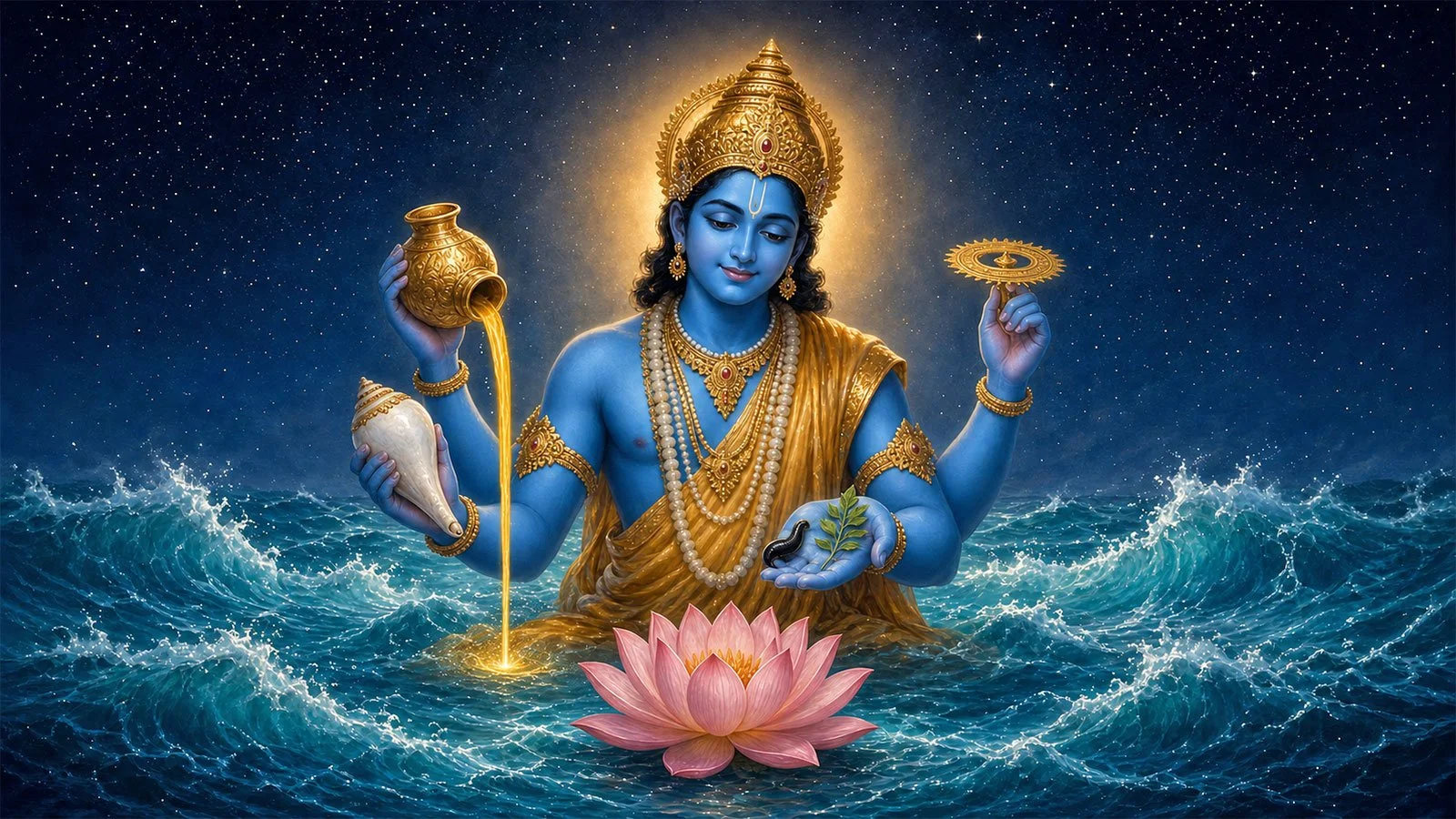
The Ocean That Gave Up Its Secrets
Before there was a system called Ayurveda, before there were doshas to name or daily routines to follow, there was an ocean, a mountain used as a churning rod, and two exhausted sides who could not agree on anything except that they both wanted what the ocean was hiding. What rose out of that churning, according to the story, was medicine itself, carried in the hands of a god.
This is the story of Dhanvantari, the physician who appears at the exact moment the tradition of Ayurveda needs a face and a source. If the doshas and dinacharya are the grammar of the system, Dhanvantari is the reason the grammar was ever spoken aloud.
The setting is the Samudra Manthan, the churning of the cosmic ocean of milk. Devas and asuras, gods and demons, agree to a temporary truce so they can churn the ocean together using Mount Mandara as the rod and the serpent Vasuki as the rope, all of it in pursuit of amrita, the nectar that grants immortality. The full account appears across several Puranic sources, most notably the Vishnu Purana.1 After ages of churning and a long procession of treasures rising from the depths, Dhanvantari finally emerges, holding a pot of amrita in his hands. Hindu tradition counts him among the avatars of Vishnu, and the Puranas name him directly as the deity associated with Ayurveda.2
One God, Two Lives
Here is where the story does something most healing myths don't bother to do. It doesn't stay in heaven.
Tradition holds that Dhanvantari appeared a second time, this time on earth, born as Divodasa, King of Kashi, the ancient city now known as Varanasi. In this incarnation he is no longer a distant figure emerging from a churned ocean. He is a teacher, approached by a group of sages who wanted to learn medicine directly. One of those students was Sushruta, whose name is still spoken with reverence anywhere surgery is taught.
Academic accounts of this lineage describe a careful chain of transmission: Brahma is said to have first articulated the knowledge, passing it to Daksha, who gave it to the Ashwins, who gave it to Indra, who in turn taught it to Dhanvantari in his form as Divodasa. Divodasa then taught Sushruta and a circle of other students, a group later remembered as the Dhanvantara-Sampradaya, the lineage of surgery.3 Sushruta took what he learned and composed the Sushruta Samhita, the text that still anchors the surgical branch of the tradition today. Inside that same text, Dhanvantari is described in his divine form as the god who freed the other gods from senility, disease, and death.4 The heavenly physician and the earthly teacher are held together, deliberately, as one continuous figure.
It's worth sitting with that structure for a moment, because it tells you something about how the tradition understands the relationship between the sacred and the practical. Dhanvantari isn't only a myth that explains where medicine came from. He is also, in the same breath, a teacher with named students, a school of thought, and a surviving text. The tradition never asked its practitioners to choose between reverence and rigor. It built room for both.
Why Vishnu
Vishnu's relationship to Dhanvantari deserves more than a passing mention, because it isn't incidental. Within the broader Hindu framework, Vishnu is understood as the preserver, the force that sustains the ordered world once it exists, distinct from Brahma who creates and Shiva who dissolves. An avatar of Vishnu is, by definition, a descent undertaken to restore balance when something threatens to come apart.
Dhanvantari's arrival fits that logic precisely. He surfaces at the exact moment health and immortality are at stake, holding not a weapon but a vessel of nectar, and tradition places him among Vishnu's avatars for that reason.2 He carries Vishnu's own emblems, the conch and the discus, alongside the healer's tools, the pot of amrita and, in many depictions, a leech, a reminder of how old the practice of bloodletting is within this tradition. The imagery itself makes the point before any text explains it: this is preservation given a physician's hands.
The Ocean Came First
It's easy, especially in wellness spaces, to fixate on amrita as a kind of literal fountain-of-youth story, a magic substance to chase. That reading misses what the story is actually doing.
Amrita in this myth isn't a product. It's the outcome of an enormous, cooperative, exhausting effort, one that required opposing forces to work the same rope for a very long time before anything worth having appeared. Read that way, the nectar isn't a shortcut to health. It's what emerges after sustained, patient labor, applied to something as vast and unwieldy as an ocean. That's a very different story than the one sold on a bottle labeled with Dhanvantari's image and a promise of instant vitality.
Modern wellness marketing has borrowed Dhanvantari's iconography while frequently discarding the structure that made him meaningful in the first place, the lineage, the teaching relationships, the discipline of a surgical school with named students and a surviving text. A god reduced to a logo isn't wrong exactly, but it's thin. The tradition offers something sturdier than a symbol of quick transformation: a model of medicine transmitted person to person, tested, written down, and carried forward with enough care that we can still trace its authorship two and a half thousand years later.
Dhanvantari Today
Dhanvantari's presence hasn't stayed confined to old texts. Since 2016, India's Ministry of AYUSH has marked National Ayurveda Day on Dhanvantari Jayanti, also known as Dhanteras, the day tradition holds as his emergence from the churned ocean. In 2025, the observance shifted to a fixed date, September 23 every year, specifically so the day could be recognized consistently on a global calendar rather than tracking the lunar cycle.5 Health camps, seminars, and awards given in his name still carry his image forward, the same pot of nectar, the same quiet claim that healing is worth pausing the calendar to honor.
There's something fitting in that continuity. A god who once had to earn his medicine through churning is still, in his way, asking anyone who invokes him to slow down long enough to actually do the work.
This piece continues the conversation from Ayurveda and the Knowledge of Life and our exploration of Asclepius, God of Healing and the Temples of Dream — tracing the thread of divine teachers, immortality, and the healer's relationship to death across traditions.
Sources
1. ↩ Wikipedia. "Dhanteras." Describes the Samudra Manthan account of Dhanvantari's emergence with amrita, sourced to the Vishnu Purana.
2. ↩ Wikipedia. "Dhanvantari." Summarizes his status as an avatar of Vishnu and the Puranic designation as deity of Ayurveda, with citations to primary Puranic sources.
3. ↩ Paliwal, M. et al. "Sushruta, A Great Surgeon and Visionary of Ayurveda." International Journal of Research in Ayurveda and Pharmacy, 3(1), 2012, Faculty of Ayurveda, Institute of Medical Sciences, Banaras Hindu University.
4. ↩ Indic Civilizational Portal. "Classical Indic Medicine II, History of Ayurveda." Cites the Sushruta Samhita's description of Dhanvantari and his surgical disciples.
5. ↩ Press Information Bureau, Government of India, Ministry of Ayush. "Ayurveda Day to Be Marked on 23 September Annually from 2025."