
The I Ching, An Ancient Oracle for the Modern Seeker
A Living System of Wisdom and Change
There is something quietly radical about sitting with a question you don't yet know how to answer — and trusting that stillness itself might offer a response. This is the heart of the I Ching, one of humanity's oldest wisdom traditions, and one that feels remarkably alive in our modern world of overstimulation and constant noise.
At Kusala Healing Arts, we are always drawn to practices that bring us back to ourselves. The I Ching is one of those rare tools that does exactly that — not by giving you answers from the outside, but by inviting you into a deeper conversation with your own inner knowing.
A 3,000-Year-Old Book That Still Has Something to Say
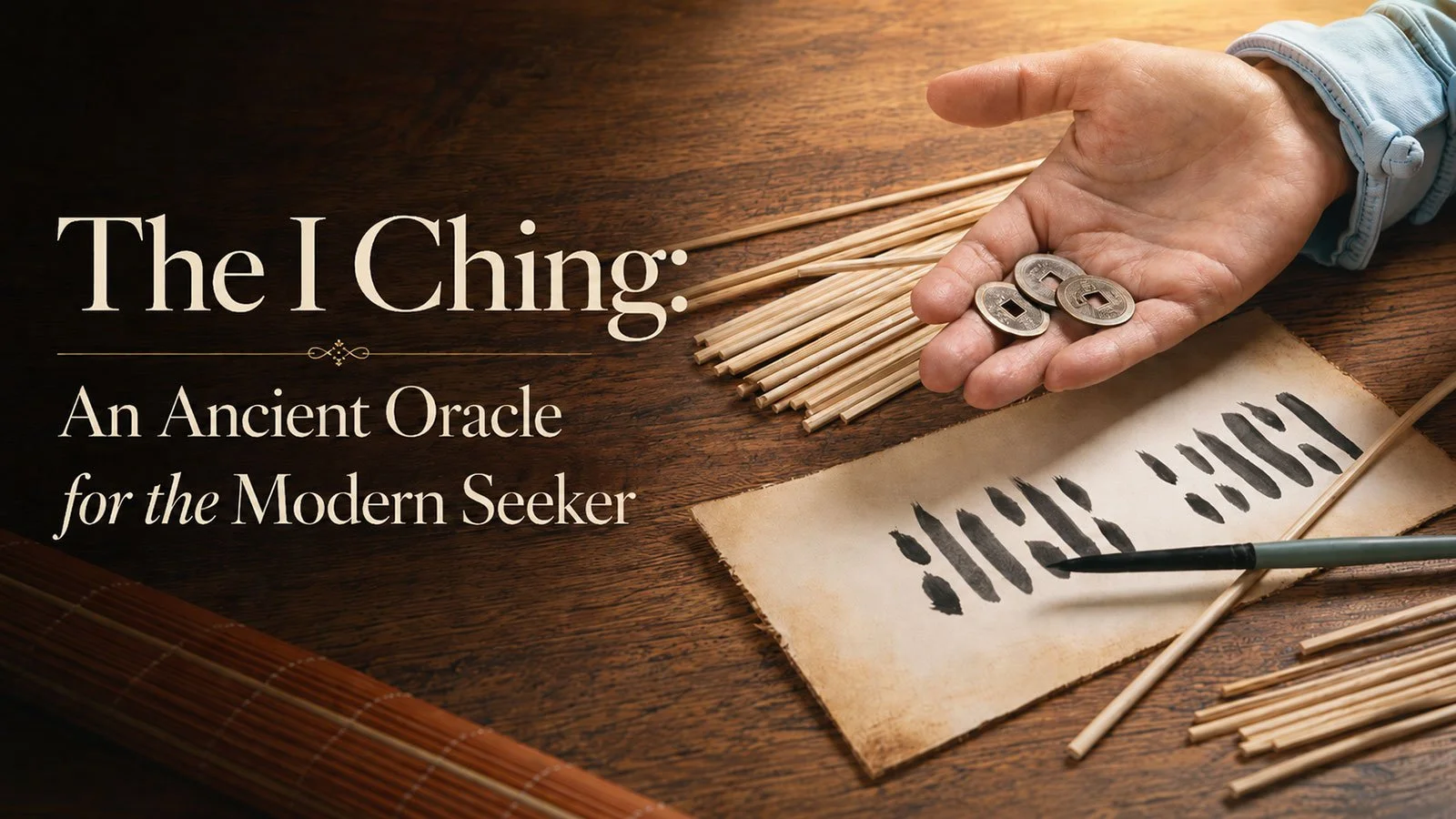
The I Ching, often translated as The Book of Changes, is a Chinese divination text with roots stretching back over three thousand years. Consulted by emperors, philosophers, healers, and everyday seekers alike, it is considered one of the oldest books in existence. Confucius himself is said to have studied it so devotedly that the binding of his copy wore out three times over.
At its core, the I Ching is built from a beautifully simple foundation: the interplay of broken and unbroken lines — one receptive, one active. From these two symbols, an entire cosmology unfolds across three layers: the Bagua, the eight trigrams it organizes, and the sixty-four hexagrams those trigrams combine to create.
The Bagua — A Map of All That Changes
The Bagua, translated as eight symbols, is the cosmological framework that gives the I Ching its structure. Depicted as an octagonal arrangement of the eight trigrams, it organizes the fundamental forces of nature, time, and human experience into a coherent whole — a map of where you stand within the constant motion of change.
Two classical arrangements exist. The Earlier Heaven Bagua, attributed to the sage Fu Xi, is the primordial order — Heaven and Earth facing each other across the circle, Fire opposite Water, Thunder opposite Wind. It represents the ideal blueprint of the universe before it enters the flow of time, and is most often used in feng shui and energy work.
The Later Heaven Bagua, attributed to King Wen, is the arrangement of the world as it actually moves through time — the cycle of seasons made visible. Fire rests in the south at the height of summer, Water in the north at the depth of winter, Thunder rises in the east with spring's awakening, and Lake settles in the west as autumn arrives. This is the Bagua most directly connected to I Ching divination and the one most resonant for those drawn to healing and inner work. It offers a profound reminder: we are not separate from the seasonal and elemental cycles around us. Our bodies know winter. Our nervous systems respond to spring.
The Eight Trigrams — The Building Blocks of Change
Within the Bagua live the eight trigrams — three-line combinations of yin and yang that form the essential vocabulary of the I Ching. Think of them less as symbols to memorize and more as eight distinct qualities of energy, each with a characteristic way of moving through the world.
☰ Qián — Heaven. Three unbroken yang lines. Pure creative force, leadership, and expansive will. Positioned in the northwest, this is the energy of initiative and far-reaching possibility.
☷ Kūn — Earth. Three broken yin lines. Pure receptivity and nurturing strength. Resting in the southwest, this is the quiet power of devoted, steady support.
☳ Zhèn — Thunder. Rising in the east, the direction of spring. A yang line beneath two yin lines — sudden movement and the shock that initiates change. The energy of new beginnings stepping forward.
☴ Xùn — Wind and Wood. Occupying the southeast. Gentle persistence and penetrating adaptability. Like wind finding its way through every opening, this energy works through sustained subtle influence rather than force.
☵ Kǎn — Water. Resting in the north, the direction of winter and depth. A yang line between two yin lines — flowing through obstacles, navigating difficulty with trust. Water does not resist what it meets. It moves around, through, and beneath.
☲ Lí — Fire. Holding the south at the height of summer. A yin line between two yang lines — clarity, illumination, and radiant awareness. Brilliant and warming, and dependent on what it clings to for fuel.
☶ Gèn — Mountain. Sitting in the northeast, the threshold between the old year and the new. Two yin lines beneath a yang line — stillness, meditation, and the wisdom of knowing when to stop. The mountain simply holds its ground with complete presence.
☱ Duì — Lake. Resting in the west with autumn. Two yang lines beneath a yin line — joy, openness, and the pleasure of exchange. Like still water reflecting the sky, this energy is receptive and deeply nourishing.
These eight forces describe real qualities of energy — in nature, in our bodies, in our relationships, and in the seasons of our lives. Learning to recognize them is the beginning of a profound inner literacy.
The Sixty-Four Hexagrams
When two trigrams are stacked — one below, one above — a hexagram is formed. Six lines, 64 possible combinations, and a complete map of the situations and inner states that make up a human life.
The lower trigram represents your inner condition — what is happening beneath the surface. The upper trigram reflects the outer situation — the environment and forces at play around you. Reading a hexagram means reading the relationship between these two: how your inner world is meeting the outer one, and what quality of response the moment is calling for.
Hexagram 48 — The Well (Wind below, Water above) speaks of returning to essential nourishment. No matter how many draw from the well, the water remains. The question it poses is whether you have the right vessel to receive what is being offered.
Hexagram 29 — The Abysmal (Water doubled) is about moving through genuine difficulty without losing your center. Water does not panic when it meets a rock. It finds the way through. This hexagram does not promise things will be easy — it promises the way through exists.
Hexagram 52 — Keeping Still (Mountain above Mountain) is one of the I Ching's most meditative teachings — a direct invitation to stop, grow quiet, and cease the restless movement of the mind. At Kusala, this hexagram feels like a close companion. Whether in meditation, sound healing, or hands-on therapy, we return again and again to this truth: stillness is not emptiness. It is presence. And presence is where healing begins.
Each line within a hexagram can also be moving — in the process of shifting from yin to yang or vice versa — generating a second hexagram that shows where the energy is heading. Nothing holds still. Every reading is a snapshot of movement in the constant dance between receptivity and action.
The I Ching as a Contemplative Practice
What resonates most deeply for us at Kusala is the way the I Ching functions as a contemplative tool — something to sit with, not just read through. After casting a hexagram, many practitioners enter a short meditation, holding the trigrams in awareness: What does Wind moving through Water feel like in my body? Where do I sense Mountain energy right now? These are somatic questions — invitations to feel the teaching rather than only understand it.
The Bagua itself can become a meditation object, tracing the seasonal movement from Thunder in the east through Fire in the south, Lake in the west, and Water in the north — a reminder that we belong to these cycles and are expressions of them, not observers of them.
Carl Jung, who wrote the foreword to one of the I Ching's most beloved English translations, called this quality synchronicity — the meaningful coincidence between the hexagram that arises and the inner truth the seeker is living. The I Ching, he believed, offered a window into the unconscious that few Western tools could match.
An Invitation to Listen More Deeply
You do not need to believe in divination to benefit from the I Ching. You only need to be willing to slow down, hold a real question in your heart, and listen. Whether you are navigating a life transition, a difficult relationship, a season of grief, or a long stretch of uncertainty, the I Ching offers companionship and orientation — a reminder that within the patterns of change, there is always a way forward.
We would love to explore this with you. If you feel called to integrate practices like the I Ching into your contemplative life, we warmly invite you to join us at Kusala Healing Arts — where our sound healing sessions, and integrative therapies create space for exactly this kind of unhurried, grounded inner work.