

The Living Rivers of Chinese Medicine and the Classical Tradition
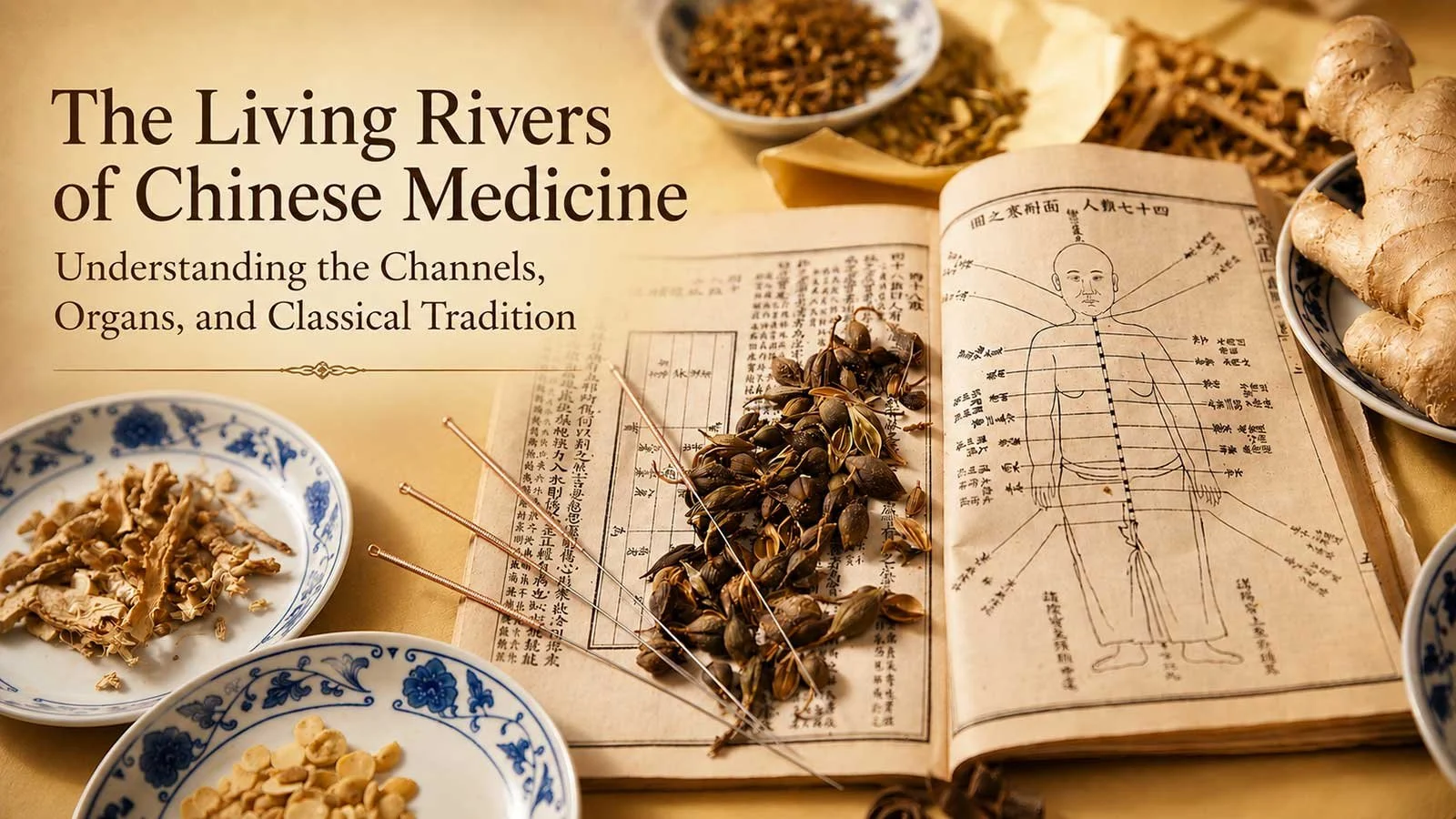
A Different Way of Seeing
One of the greatest misconceptions about Chinese medicine is that it is merely an alternative method of treating symptoms. In reality, the classical tradition presents something much broader: a way of understanding life itself.
For thousands of years, physicians, scholars, monks, Daoists, and healers observed nature and the human body, searching for patterns that connected heaven, earth, and humanity. Their observations eventually formed the foundation of what we now call Traditional Chinese Medicine (TCM), though many practitioners today look beyond modern TCM and return to the classical texts that inspired it.
Among the most important of these works are the Huangdi Neijing (Yellow Emperor's Inner Classic), the Nanjing (Classic of Difficult Issues), the Shang Han Lun (Treatise on Cold Damage), and the Jingui Yaolue (Essential Prescriptions from the Golden Cabinet). These texts describe a medicine rooted in relationship, balance, and observation rather than the isolation of individual symptoms.
In the classical view, health is not simply the absence of disease. Health is the harmonious movement of life.
And nowhere is this idea more clearly expressed than in the channel system.
The Channels as Rivers of Communication
The channels, often called meridians in English, are among the most distinctive features of Chinese medicine.
Rather than viewing the body as a collection of separate organs and tissues, classical Chinese medicine sees the body as an interconnected network. The channels serve as pathways through which Qi, Blood, fluids, information, and influence circulate.
The ancient physicians often compared them to rivers and waterways.
Just as a landscape depends on healthy streams, lakes, and rivers, the body depends on the smooth movement of Qi through its channels. When the flow becomes obstructed, excessive, deficient, or chaotic, symptoms arise.
Pain, for example, was often described in the classics as a manifestation of blockage:
"If there is free flow, there is no pain. If there is pain, there is no free flow."
The channels connect the exterior and interior, the organs and tissues, the emotions and physiology, and even the individual with the larger rhythms of nature.
The Twelve Primary Channels
The classical system describes twelve primary channels, each associated with an organ network.
These channels form six paired relationships based upon Yin and Yang.
The Lung Channel (Taiyin)
Organ: Lung
The Lung governs respiration and oversees the movement of Qi throughout the body. In classical thought, the Lung acts as the "canopy" of the organs, distributing Qi and fluids downward.
The Lung channel begins in the chest and travels down the inner arm to the thumb.
Its functions include:
Respiration
Defensive Qi (Wei Qi)
Skin and pores
Grief and letting go
The Lung teaches rhythm, much like breathing itself.
The Large Intestine Channel (Yangming)
Organ: Large Intestine
Paired with the Lung, the Large Intestine channel travels from the index finger up the arm to the face.
Its role extends beyond physical elimination.
Classically, it is associated with releasing what is no longer needed—physically, emotionally, and energetically.
Functions include:
Elimination
Regulation of fluids
Clearing excess
Letting go
The Stomach Channel (Yangming)
Organ: Stomach
The Stomach channel is one of the most abundant channels in terms of Qi and Blood.
Running from the face down the front of the body and legs, it plays a central role in nourishment.
Functions include:
Digestion
Receiving food and drink
Production of Qi and Blood
Grounding and stability
Many classical physicians considered the Stomach Qi to be one of the strongest indicators of vitality.
The Spleen Channel (Taiyin)
Organ: Spleen
The Spleen channel ascends from the foot to the chest.
In Chinese medicine, the Spleen is far more than the anatomical spleen. It governs transformation and transportation—the process of turning food into usable energy.
Functions include:
Digestion
Blood containment
Muscle nourishment
Thought and concentration
The Spleen is often described as the source of postnatal Qi.
The Heart Channel (Shaoyin)
Organ: Heart
The Heart is known in the classics as the Emperor.
Its channel travels from the chest down the inner arm to the little finger.
Functions include:
Circulation of Blood
Housing the Shen (Spirit)
Consciousness
Emotional balance
In classical medicine, a calm and settled Heart supports clarity, wisdom, and peaceful sleep.
The Small Intestine Channel (Taiyang)
Organ: Small Intestine
The Small Intestine channel travels from the hand to the face and ear.
Its primary function is often described as "separating the pure from the impure."
This applies not only to digestion but also to discernment.
Functions include:
Assimilation
Sorting and processing
Mental clarity
The Bladder Channel (Taiyang)
Organ: Urinary Bladder
The Bladder channel is the longest channel in the body.
Running from the eyes over the head and down the back and legs, it contains many important points associated with the internal organs.
Functions include:
Fluid regulation
Nervous system influence
Back health
Access to organ function through Back-Shu points
The channel acts almost like a map of the body's internal landscape.
The Kidney Channel (Shaoyin)
Organ: Kidney
The Kidney channel begins beneath the foot and ascends through the legs into the torso.
The Kidneys are considered the root of life.
Functions include:
Essence (Jing)
Growth and development
Reproduction
Bone health
Willpower
Classical texts frequently describe Kidney Jing as the foundation from which life unfolds.
The Pericardium Channel (Jueyin)
Organ: Pericardium
The Pericardium protects the Heart.
Its channel runs from the chest down the inner arm to the middle finger.
Functions include:
Emotional protection
Circulation
Heart support
Relationship and connection
Many practitioners regard it as the channel most closely associated with interpersonal warmth and intimacy.
The Triple Burner Channel (Shaoyang)
Organ: San Jiao (Triple Burner)
The Triple Burner has no direct anatomical equivalent in Western medicine.
Instead, it represents functional relationships within the body.
Functions include:
Regulation of fluids
Communication between organ systems
Temperature regulation
Coordination of physiological processes
The San Jiao is often described as a system of passageways through which Qi and fluids move.
The Gallbladder Channel (Shaoyang)
Organ: Gallbladder
The Gallbladder channel winds across the side of the head and body before descending the leg.
Functions include:
Decision-making
Courage
Bile secretion
Movement and adaptability
In classical medicine, a healthy Gallbladder contributes to confidence and clear action.
The Liver Channel (Jueyin)
Organ: Liver
The Liver channel rises from the foot through the inner leg into the torso.
The Liver ensures the smooth movement of Qi throughout the body.
Functions include:
Regulation of Qi
Blood storage
Emotional flow
Tendon health
Vision
Many common modern complaints involving stress, frustration, and stagnation are associated with Liver dysfunction.
The Organ Networks Beyond Anatomy
One of the most important concepts for modern readers to understand is that Chinese organs are functional systems rather than merely physical structures.
When a classical physician refers to the Liver, they are not simply discussing the liver seen on an anatomical chart.
The Liver includes movement, planning, flexibility, tendons, eyes, emotions, and the free flow of Qi.
Likewise:
The Heart governs spirit and consciousness.
The Spleen governs transformation and nourishment.
The Lung governs rhythm and protection.
The Kidney governs essence and longevity.
Each organ participates in a larger web of relationships.
This perspective allows Chinese medicine to examine health through patterns rather than isolated diseases.
The Extraordinary Vessels
Beyond the twelve primary channels are the Eight Extraordinary Vessels.
These deeper pathways function as reservoirs and regulators of Qi.
Among them are:
Governing Vessel (Du Mai)
Conception Vessel (Ren Mai)
Penetrating Vessel (Chong Mai)
Belt Vessel (Dai Mai)
Classical practitioners often viewed these vessels as gateways into deeper constitutional and developmental patterns.
They influence identity, ancestry, growth, and long-term transformation.
Returning to the Classics
The classical texts remind us that medicine is not merely about intervention.
It is about observation.
The physician learns to observe seasons, climate, emotions, sleep, digestion, pulse qualities, complexion, voice, posture, and countless subtle signs.
The goal is not simply to suppress symptoms but to understand the pattern from which those symptoms emerge.
This requires patience.
It requires listening.
And perhaps most importantly, it requires recognizing that the body possesses an innate intelligence constantly seeking balance.
A Medicine of Relationship
At its heart, classical Chinese medicine is a medicine of relationship.
It examines the relationship between organs, channels, emotions, seasons, food, environment, and spirit.
The channels serve as living rivers connecting these relationships throughout the body. The organs function as dynamic networks rather than isolated structures. The classics provide a framework for understanding how these systems interact in health and disease.
While modern technology continues to transform healthcare, the enduring wisdom of Chinese medicine offers something that remains deeply relevant: a reminder that human beings are not machines composed of separate parts.
We are living systems.
The ancient physicians understood this well. They observed the movements of wind through trees, water through valleys, and stars through the heavens, and saw reflections of those same movements within the human body.
To study the channels and organs is therefore more than learning anatomy or memorizing acupuncture points. It is an invitation to see ourselves as part of a larger pattern—one in which health emerges not from control, but from harmony.