
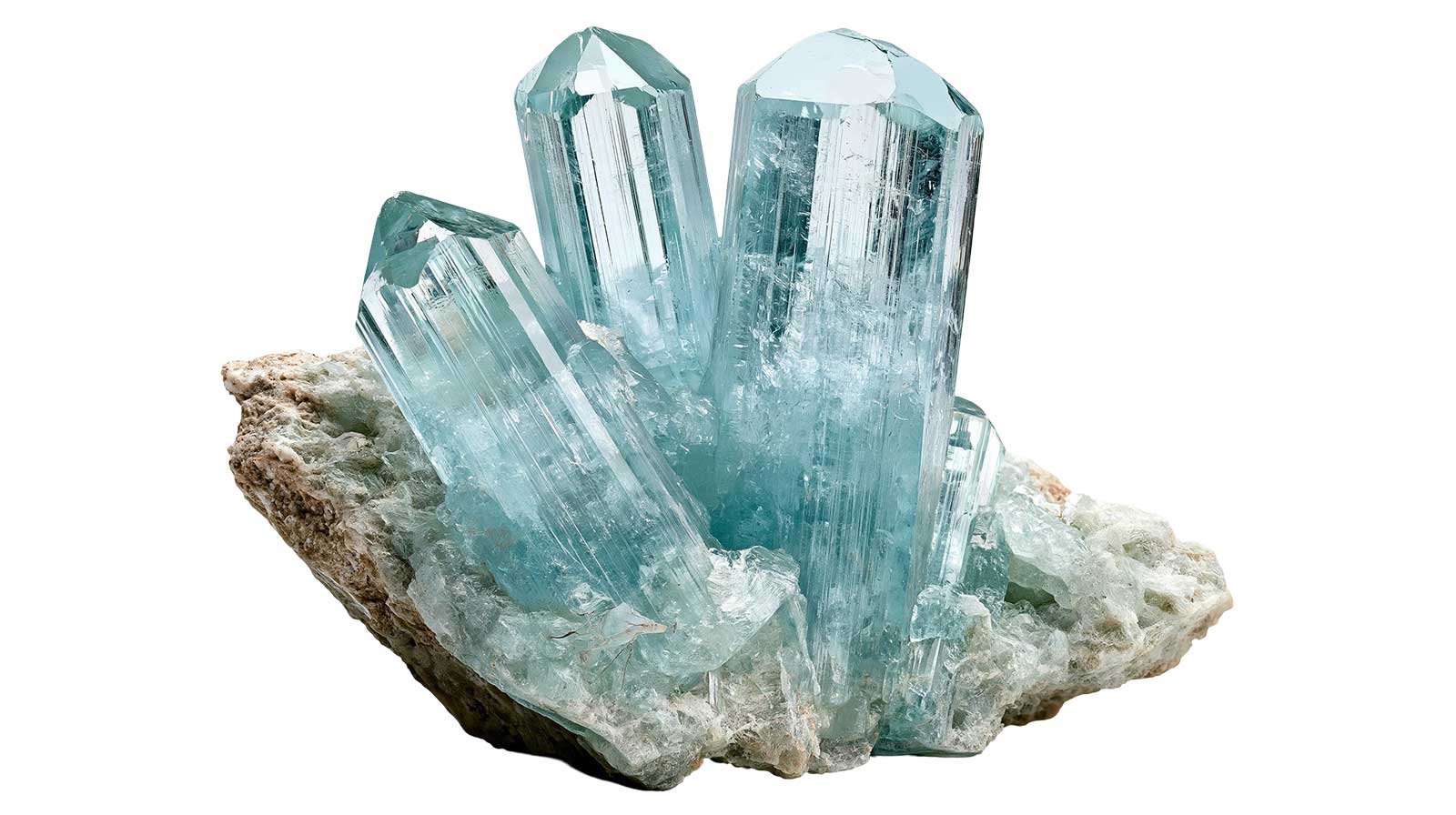
Aquamarine, the blue variety of beryl, in its natural six-sided crystals.
When we followed lapis lazuli out of the mountains of Badakhshan, the trail ended in Tibet, with the Medicine Buddha, the King of Lapis Lazuli Light. That story holds, as far as it goes. But we also saw how freely gem names wander, with Europe calling lapis sapphirus for over a thousand years. The Sanskrit word in the Medicine Buddha's name, vaiḍūrya (वैडूर्य), wandered further than most, and it may first have meant a clear, sea-colored crystal the Greeks called beryl. This post follows that second thread.
In This Article
- A Word That Traveled West
- What Beryl Actually Is
- Lapis, Beryl, or Cat's Eye
- The Blue Beryl of Tibetan Medicine
- Beryl in the Medieval Pharmacy
- Holding Beryl Today
A Word That Traveled West
Few gem names have traveled as far as this one. The English word beryl comes through Old French and Latin from the Greek bēryllos (βήρυλλος), which most likely borrowed it from a Prakrit form, veruliya, descended from Sanskrit vaiḍūrya.1 The Sanskrit word may itself be Dravidian, possibly tied to the town of Belur in southern India.
The Pali canon knows the same stone as veḷuriya, and Buddhist texts reach for it again and again as a figure for something precious and flawless.2
The word kept moving after it reached Europe. Medieval Latin used berillus for pale green gems, for fine crystal, and even for eyeglasses, since the earliest spectacle lenses may have been ground from beryl. German still calls glasses Brille for that reason.1
So a single word links a Buddhist healing figure to a pair of reading glasses. That alone earns beryl a place in a series on stone medicine. Its story is less about what the stone cures than about what it helps us see.
What Beryl Actually Is
Beryl is a beryllium-bearing mineral that grows in long, six-sided prisms. Its many colors come from trace elements. Chromium or vanadium makes emerald, manganese makes pink morganite, and iron makes the blue to green-blue stone we now call aquamarine.3
Much of the aquamarine on the market today has also been heat-treated, which pushes the color toward a cleaner blue.4 That detail matters for our story. The deep, saturated blue of many Medicine Buddha paintings is not the usual color of natural blue beryl, which tends toward the pale green-blue of shallow water.
The Romans knew this stone well. Pliny the Elder, writing in the first century, considered beryls close kin to emerald, said the finest came from India, noted that cutters shaped them into six-sided forms, and prized above all those with the clear green of the sea.5 He was right about the family resemblance nearly two thousand years before mineralogy could prove it.
Lapis, Beryl, or Cat's Eye
Here the story gets tangled, and the tangle is the point. The Medicine Buddha's full Sanskrit name is Bhaiṣajyaguru-vaiḍūrya-prabha (भैषज्यगुरुवैडूर्यप्रभ), the Master of Medicine whose light is vaiḍūrya. In the sutra that bears his name, his second great aspiration asks that his body become like that jewel, utterly pure inside and out, stainless and luminous.6
Most English readers know him by the title our lapis post used, King of Lapis Lazuli Light, and that translation is old and widespread. Yet 84000, a nonprofit project translating the Tibetan Buddhist canon into English, renders the word as blue beryl. Its translators reason that the descriptions in both Sanskrit and Tibetan literature fit beryl better than lapis.6
A Tibetan-English reference wiki maintained by translators adds that the lapis meaning appears only in Tibet and China, while earlier sources seem to mean beryl fairly consistently until around the fifteenth century.7 The physical argument is simple. The sutra describes a body clear inside and out. Lapis lazuli is opaque, a rock rather than a single crystal. Beryl is transparent.
Still, the case is not closed. Monier-Williams's classic Sanskrit dictionary glosses vaiḍūrya as a cat's-eye gem,7 and in Rasashastra, Ayurveda's mineral pharmacy, the thirteenth-century Rasaprakāśasudhākara lists it as cat's eye among the nine gems, or navaratna.8
The librarian Marianne Winder devoted a full study to the problem, weighing beryl, cat's eye, and lapis against Pali, Tibetan, and Chinese evidence.9 A more recent study of ancient Indian texts found that the color comparisons range across green, blue, and duller shades, yet still proposed beryl as the closest match.10
One English translation of the Four Tantras captures the uncertainty in a single sentence, calling the Medicine Buddha the King of Aquamarine Light while seating him on a throne of lapis lazuli. Both readings sit side by side, drawn from the same Tibetan word.7
The fairest answer, then, is that the stone in the Medicine Buddha's name was probably beryl in its earliest sense, and became lapis as the tradition moved north and east. Neither reading is wrong within its own setting. They belong to different chapters of the same story.
The Blue Beryl of Tibetan Medicine
In Tibet, beryl's most enduring role is not as a stone at all but as a book title. In the late seventeenth century, Desi Sangye Gyatso (སྡེ་སྲིད་སངས་རྒྱས་རྒྱ་མཚོ), regent to the Fifth Dalai Lama, wrote a vast commentary on the Four Tantras, or Gyüshi (རྒྱུད་བཞི), the foundational text of Sowa Rigpa, the Tibetan science of healing. He called it the Blue Beryl, Vaiḍūrya Ngönpo (བཻ་ཌཱུརྱ་སྔོན་པོ), and its full title presents it as an ornament to the Medicine Buddha's mind and a lamp that lights up the Four Tantras.11
The regent did not stop at text. Between roughly 1687 and 1697 he oversaw a set of seventy-nine medical paintings that follow the structure of the Blue Beryl closely.12 They depict anatomy, embryology, pulse and urine diagnosis, medicinal plants, and daily conduct, sometimes with dozens of small captioned scenes on a single cloth. Several open with great branching trees whose trunks, branches, and leaves lay out the whole medical system at a glance. Early twentieth-century copies of the set survive today, including one held in Ulan-Ude, Buryatia.12
These were teaching tools. The set was first displayed for students at the Chakpori medical college in Lhasa, which opened in 1696 across from the Potala Palace. It served as a visual memory map for doctors who had to hold the Four Tantras and its commentary in their heads for exams and clinical work.12
Sangye Gyatso returned to the image again and again. A history of Tibetan medicine he finished in 1703 is called the Mirror of Beryl,11 and his work on the related science of astrology carries the name White Beryl.12 In each case the stone stands for the same quality. It is clear, it holds light, and it lets you see through to what is there.
Beryl in the Medieval Pharmacy
Western Europe gave beryl a more literal medical role. In her Physica, written in the mid-twelfth century, Hildegard of Bingen treats gemstones alongside herbs, trees, animals, and metals as natural remedies.13 She describes beryl as a warm stone born when the late-morning sun bears down on the foam of water, so that it holds more of air and water in its nature than of fire.
Her prescription is specific. Someone who has swallowed poison should place a little beryl in spring water and drink it while fasting, once a day for five days, until the poison is purged from the body.13
To a modern reader this sounds like magic. To Hildegard it was natural philosophy. Her medicine rested on the classical theory of the humors and elements, in which a stone's healing virtue came from the balance of heat and moisture fixed into it as it formed. Beryl's watery, sun-warmed nature made it a cleanser.
This is a historical prescription, not a recommendation. Beryl is the main ore of beryllium, and gem elixirs made from mineral stones are not something to experiment with at home.
Whatever we make of her reasoning, the instinct runs parallel to Tibet's. Both traditions saw in beryl a kind of purity, something that clears what has become clouded.
Holding Beryl Today
Aquamarine is often sold today as a stone of calm, of the throat, and of clear communication. Those associations are recent. They do not appear in Pliny, in Hildegard, or in the Blue Beryl, and they belong to a newer layer of practice rather than to the classical record.
What the older sources offer is quieter. Across India, Tibet, and Europe, beryl kept becoming a word for clarity itself. It named a body pure inside and out, a commentary that lights up a difficult text, and a lens that helps tired eyes read. Its medicine was mostly metaphor, and the metaphor was transparency.
That may be the most useful way to keep one close now. Set beside you while you sit, a piece of blue beryl works as a reminder rather than a remedy. It recalls the Medicine Buddha's second aspiration, that a healer might be clear all the way through, with nothing hidden between intention and action. For anyone whose work places their hands on another person's body, that is a high and worthy standard.
And if your stone turns out to be lapis, or cat's eye, or something else entirely, the tradition has already made room for that. The word was always larger than any one mineral.
To trace the deep blue reading of this same name, return to Lapis Lazuli and the Long Memory of Stone Medicine, and for the healer whose light both stones describe, continue with The Medicine Buddha and the Road from Sutra to Clinic.
Sources
- ↩ Harper, D. "Beryl." Online Etymology Dictionary. etymonline.com/word/beryl
- ↩ 84000 Translating the Words of the Buddha. "Beryl (vaiḍūrya)." 84000 Glossary. 84000.co/glossary/43761
- ↩ Gemological Institute of America. "Beryl." GIA's Gübelin Gem Project. gia.edu/gia-gem-project-beryl
- ↩ Gemological Institute of America. "Aquamarine Description." GIA Gem Encyclopedia. gia.edu/aquamarine-description
- ↩ Pliny the Elder. Natural History, Volume X: Books 36–37. Trans. D. E. Eichholz. Loeb Classical Library 419. Harvard University Press, 1962. Book 37, §76. Loeb edition, vol. X
- ↩ 84000 Translation Team, trans. The Detailed Account of the Previous Aspirations of the Blessed Bhaiṣajyaguruvaiḍūryaprabha (Toh 504). 84000: Translating the Words of the Buddha. scholar.84000.co/translation/toh504
- ↩ "bai dU rya." Rangjung Yeshe Wiki, Dharma Dictionary. Tsadra Foundation. rywiki.tsadra.org/index.php/bai_dU_rya
- ↩ "Vaiḍūrya." Wisdom Library, compiled definitions from Rasaśāstra, Nāṭyaśāstra, and the Cologne Digital Sanskrit Dictionaries. wisdomlib.org/definition/vaiḍūrya
- ↩ Winder, M. "Vaiḍūrya." In G. J. Meulenbeld & D. Wujastyk (eds.), Studies on Indian Medical History. Studies on Indian Medical History
- ↩ "The Gemstone Vaiḍūrya in Ancient Indian Texts." Journal of Letters, Chulalongkorn University, vol. 48, no. 2. digital.car.chula.ac.th/jletters/vol48/iss2/8
- ↩ Watt, J. (2007, updated 2020). "Blue Beryl Masterworks." Himalayan Art Resources. himalayanart.org
- ↩ Hofer, T. "Desi Sanggye Gyatso's Medical Paintings." Project Himalayan Art, Rubin Museum of Art. rubinmuseum.org/projecthimalayanart
- ↩ Hildegard von Bingen. Hildegard von Bingen's Physica. Trans. P. Throop. Healing Arts Press, 1998. Book IV, "Stones." Hildegard von Bingen's Physica