
Lapis Lazuli and the Long Memory of Stone Medicine
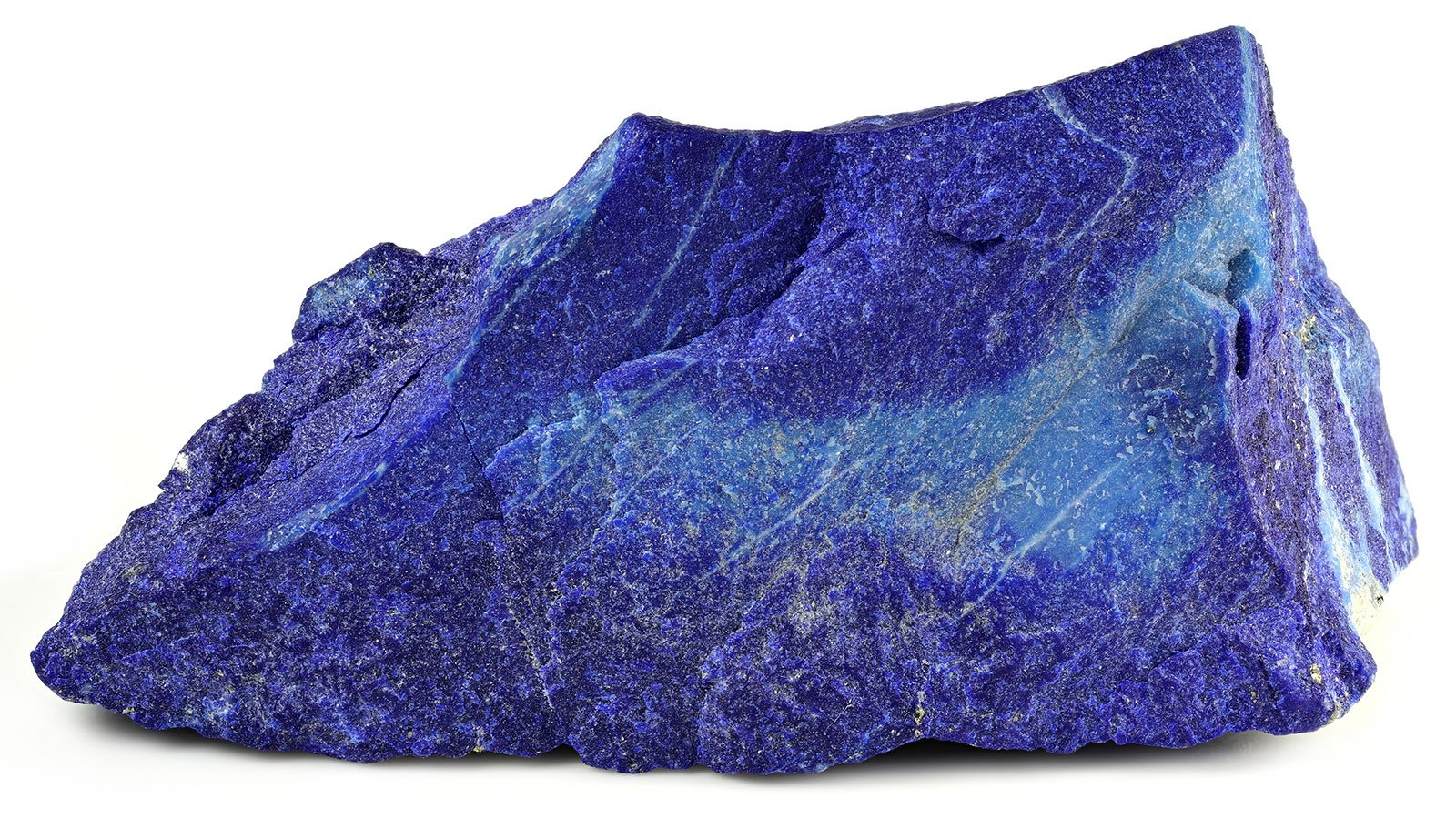
Raw lapis lazuli, its rough-cut faces deep blue with faint white marbling.
For most of human history, blue was the hardest color to hold onto. Plants gave up reds and yellows and browns easily enough, but a true, stable blue — the color of a night sky just before the stars appear — came from almost nowhere on earth. It came, more than anywhere else, from a single stretch of mountains in what is now northeastern Afghanistan, and from a stone that Sumerian priests, Egyptian physicians, Persian scholars, and Tibetan Buddhist monks all reached for. That stone is lapis lazuli, and its medicinal history is really several histories, each shaped by a different tradition’s sense of what healing is for.
A Blue Mined at the Edge of the World
Nearly everything the ancient world knew as lapis lazuli came from one place: the Sar-i Sang mines in the Kokcha River valley of Badakhshan, high in the Hindu Kush.1 Lapis objects from the Indus Valley site of Bhirrana date to roughly 7570 BCE, making it one of the oldest continuously traded luxury materials on record.1
The mines sit at high altitude and are workable only part of the year, so lapis was expensive before it ever left the mountain. Caravans carried it west into Mesopotamia, south into the Indus Valley, and eventually into Egypt, on a trade route that predates the Silk Road by thousands of years; Marco Polo still noted the mines in the thirteenth century.2 The name carries its own history: lapis is Latin for stone, while lazuli descends from the Persian lazhuward and Arabic lazaward, meaning sky — the same root that gives English the word azure.2
Mesopotamia and the Stone of the Gods
In Sumer and later Babylon, lapis lazuli was less a gemstone than a material presence of the divine. The goddess Inanna is described in Sumerian hymns wearing a lapis necklace; lapis mosaic covers the Standard of Ur, and Queen Puabi’s tomb, circa 2600 BCE, held an elaborate lapis and gold headdress.3
Mesopotamian scholar-priests treated the stone as a text as much as a substance. The Abnu šikinšu, a cuneiform stone-identification handbook, catalogs minerals by appearance and prescribes their healing and protective uses, assigning one lapis-colored stone to the “middle heaven.”4 Lapis also appears repeatedly in Assyrian medical texts as an ingredient in eye ointments, ground and worn alongside plant and mineral remedies.5 In this tradition, a stone’s cosmological rank and its clinical use justified each other.
Egypt and the Eye That Heals
Egyptian sources treat lapis with a similar seriousness, though the emphasis shifts toward the eye — unsurprising, since eye infections were endemic along the Nile. Chapter 140 of the Book of the Dead describes a lapis eye set in gold as a powerful amulet, tied to monthly offerings before a symbolic eye associated with cosmic order.6
The Ebers Papyrus, compiled around 1550 BCE, prescribes lapis alongside myrrh, honey, and other minerals for cataracts, conjunctivitis, and other eye ailments.7 Priests and pharaohs also wore lapis amulets carved as Ma’at, the principle of cosmic and social order — a physical commitment to balance as much as a medical one.5 The stone’s most famous Egyptian appearance, the lapis inlay of Tutankhamun’s funerary mask, is decorative rather than medicinal — but that line was thinner in Egyptian practice than it is in ours.
Greece and Rome and the Stone Called Sapphirus
Classical writers knew lapis lazuli well, though not by its modern name. The Greek naturalist Theophrastus, writing in the fourth century BCE, described a stone called sapphirus as speckled as if with gold — a description that fits lapis and its pyrite flecks far better than it fits the corundum gem we call sapphire today. Pliny the Elder repeated the same description centuries later, and the confusion of names held for well over a thousand years; European writers kept using sapphirus for what was almost certainly lapis lazuli well into the Middle Ages.1
Lapis reached the Aegean long before either writer, turning up in Mycenaean-era finds in Greece as evidence of trade contact with Egypt.17 Both Greeks and Romans carved it into seals, amulets, and pendants, and prized it as a mark of status. Its medicinal use in this period was modest but real: ground and mixed with milk, lapis was applied as a dressing for boils and ulcers, and Roman writers also credited it with aphrodisiac properties.16 Compared to the pharmacological detail of Mesopotamia or the later Unani and Ayurvedic traditions, Greek and Roman engagement with lapis reads more as natural history and status object than as formal medicine — but the sapphirus confusion they set in motion shaped how Europe named and understood the stone for the next fifteen hundred years.
The Indus Valley and the Roads It Traveled
The Indus Valley Civilization was lapis lazuli’s other major early market, and its role there was as much commercial as medicinal. Harappan artisans carved it into beads, seals, and inlay work, importing it from Badakhshan along routes that also carried carnelian and copper between Central and South Asia.1 That trade network is very likely the channel through which lapis entered the Indian subcontinent’s pharmacological traditions, Ayurveda among them, well before any surviving textual record of its use.
Persia and the Physicians of the Canon
By the Islamic Golden Age, Persian and Arab physicians had absorbed lapis lazuli into a formal pharmacology. Ibn Sina, known in the West as Avicenna, and the physician al-Razi both discussed mineral-origin remedies, and lapis, or lajward, became a recognized Unani treatment for an excess of sawda, or black bile, the humor tied to melancholy.8
The unrefined stone was considered harsh on the body, so practitioners used a purgative preparation only after a washing process called tadbeer. Later Unani sources extended its use to skin conditions, gynecological complaints, and cardiac and nerve disorders.8 Ibn Sina’s five-volume Canon of Medicine remained the standard medical textbook across much of Europe and the Islamic world for roughly six hundred years, carrying lapis forward as one thread among many mineral remedies.9
Ayurveda and the Question of Gem Therapy
Ayurveda developed its own tradition of gem therapy, or ratna chikitsa. Lapis lazuli appears within it as a treatment referenced for conditions including tuberculosis and urinary disorders, most notably in the thirteenth-century alchemical text Rasaratna Samuccaya.10 That text belongs to Rasashastra, the branch of Ayurvedic pharmacology specializing in processed mineral preparations, which developed detailed purification protocols before any such substance was considered fit for internal use.
That caution matters: contemporary wellness content often borrows the prestige of “Ayurvedic gemstone medicine” while skipping the purification science that made the original practice defensible. Gem therapy in classical Ayurveda is a specific, texted pharmacological tradition — not the same as the newer, broader practice of simply holding or wearing uncut crystals for their color alone.
Tibet and the Buddha of Lapis Lazuli Light
Nowhere is lapis lazuli more central to a healing tradition’s central figure than in Vajrayana Buddhism. Bhaiṣajyaguru, the Medicine Buddha, is formally titled the Medicine Guru, King of Lapis Lazuli Light, presiding over an eastern pure land described as luminous and lapis-colored.11 He is conventionally depicted with lapis-blue skin, holding a bowl of healing nectar in one hand and a medicinal plant in the other.11
The color carries doctrinal weight beyond decoration: the Bhaiṣajyaguru sutra frames the practice around twelve vows to relieve beings of physical illness, mental affliction, and material want.12 In this tradition the stone’s color is inseparable from the theology of healing itself.
It’s this Tibetan Buddhist thread, rather than Han Chinese pharmacology, that carries lapis into East Asia medicinally. Li Shizhen’s sixteenth-century Bencao Gangmu, the standard compendium of Chinese materia medica, has no entry for lapis, or qingjinshi, and the stone’s confirmed role in dynastic China is ceremonial rather than curative: Qing regulations used a lapis finial to mark a fourth-rank official’s hat and listed lapis among the approved stones for the imperial court necklace, while the emperor’s ritual robes for sacrifices at the Altar of Heaven called for lapis specifically because its color stood for the sky.15 Where the stone does carry a documented medicinal use closer to China, it’s in Mongolian medicine, an offshoot of the same Tibetan tradition, which developed its own grading of lapis quality for use as a remedy rather than treating the stone purely as an iconographic color.
Renaissance Europe and the Cost of Blue
Lapis lazuli’s role shifts again in Renaissance Europe, moving from pharmacology and theology into pigment. Ground and refined into ultramarine, it became the most expensive pigment available to European painters, reserved by patronage contracts for the robes of the Virgin Mary and other high-status subjects.13 Michelangelo used lapis-derived ultramarine in the Sistine Chapel frescoes; its expense made the color itself a visible marker of a patron’s devotion and wealth.13
Medieval European lapidaries still described the stone in medicinal terms, crediting it with keeping the limbs healthy and calming fear and melancholy — language that echoes the Unani association between lapis and black bile, likely arriving in Europe through the same Arabic medical texts that carried Ibn Sina’s Canon westward.14
What the Wellness Shelf Leaves Out
Contemporary crystal-healing literature draws on real history when it calls lapis lazuli a stone of wisdom, truth, and communication. But it tends to skip the specifics that made those associations meaningful in the first place. The Mesopotamians didn’t experience lapis as generically calming; they read it through a cosmology where specific stones belonged to specific tiers of heaven. The Unani physicians who prescribed it for melancholy required a laborious washing protocol before the stone was considered safe to ingest at all.
The Medicine Buddha’s lapis isn’t a loose gemstone on an altar, but the entire visual and doctrinal architecture of an eastern pure land. None of this makes the modern fascination with lapis illegitimate — it just makes it a much younger tradition than it often claims to be, one still worth taking seriously on its own terms rather than borrowing the authority of traditions it has mostly set aside.
This exploration of stone medicine sits alongside our look at Ayurveda and the knowledge of life and our earlier piece on perception, energy, and the invisible landscape of healing — different materials, the same old question of where matter ends and meaning begins.
Sources
- ↩ Wikipedia contributors. “Lapis lazuli.” Wikipedia. en.wikipedia.org/wiki/Lapis_lazuli
- ↩ “Lapis Lazuli History and Lore.” GIA (Gemological Institute of America). gia.edu/lapis-lazuli-history-lore
- ↩ “The Celestial Stone.” Przekrój. przekroj.org/en/art-stories/the-celestial-stone
- ↩ Wikipedia contributors. “Abnu šikinšu.” Wikipedia. en.wikipedia.org/wiki/Abnu_sikinsu
- ↩ Jewelry Appraisal Denver. “Ancient History of Lapis Lazuli.” jewelry-appraisal-denver.com/ancient-history-of-lapis-lazuli
- ↩ “The Brilliantly Blue Lapis Lazuli.” Ancient Origins. ancient-origins.net/lapis-lazuli-0017514
- ↩ “The Pharmaceutical Use of Lapis Lazuli in the Ancient East.” Academia.edu. academia.edu/9571604
- ↩ “Lajward (Lapis Lazuli): Medicinal Potential of a High-Value Gemstone in the Light of Unani Medicine.” ResearchGate. researchgate.net/publication/348381993
- ↩ “The Vast Influence of Ibn Sina, Pioneer of Medicine.” JSTOR Daily. daily.jstor.org/the-vast-influence-of-ibn-sina
- ↩ “The Pharmaceutical Use of Lapis Lazuli.” Academia.edu. academia.edu/9473338
- ↩ Wikipedia contributors. “Bhaisajyaguru.” Wikipedia. en.wikipedia.org/wiki/Bhaisajyaguru
- ↩ “Who Is Medicine Buddha.” Buddha Weekly. buddhaweekly.com/who-is-medicine-buddha
- ↩ “Lapis Lazuli Symbolism.” International Gem Society. gemsociety.org/article/history-legend-lapis-lazuli-gems-yore
- ↩ “Multi-sensory Teaching Kit and Method.” USPTO Patent Records. image-ppubs.uspto.gov/dirsearch-public/print/downloadPdf/7959442
- ↩ “Qing Dynasty Jewellery — Court Ornaments of Imperial China.” Skyjems Encyclopedia. skyjems.ca/pages/encyclopedia-qing-dynasty-jewellery
- ↩ “Lapis Lazuli.” New World Encyclopedia. newworldencyclopedia.org/entry/Lapis_lazuli
- ↩ “Lapis Lazuli.” Aurora Gems. auroragems.com/lapis-lazuli