
Siddha Medicine and the Alchemy of the Tamil South
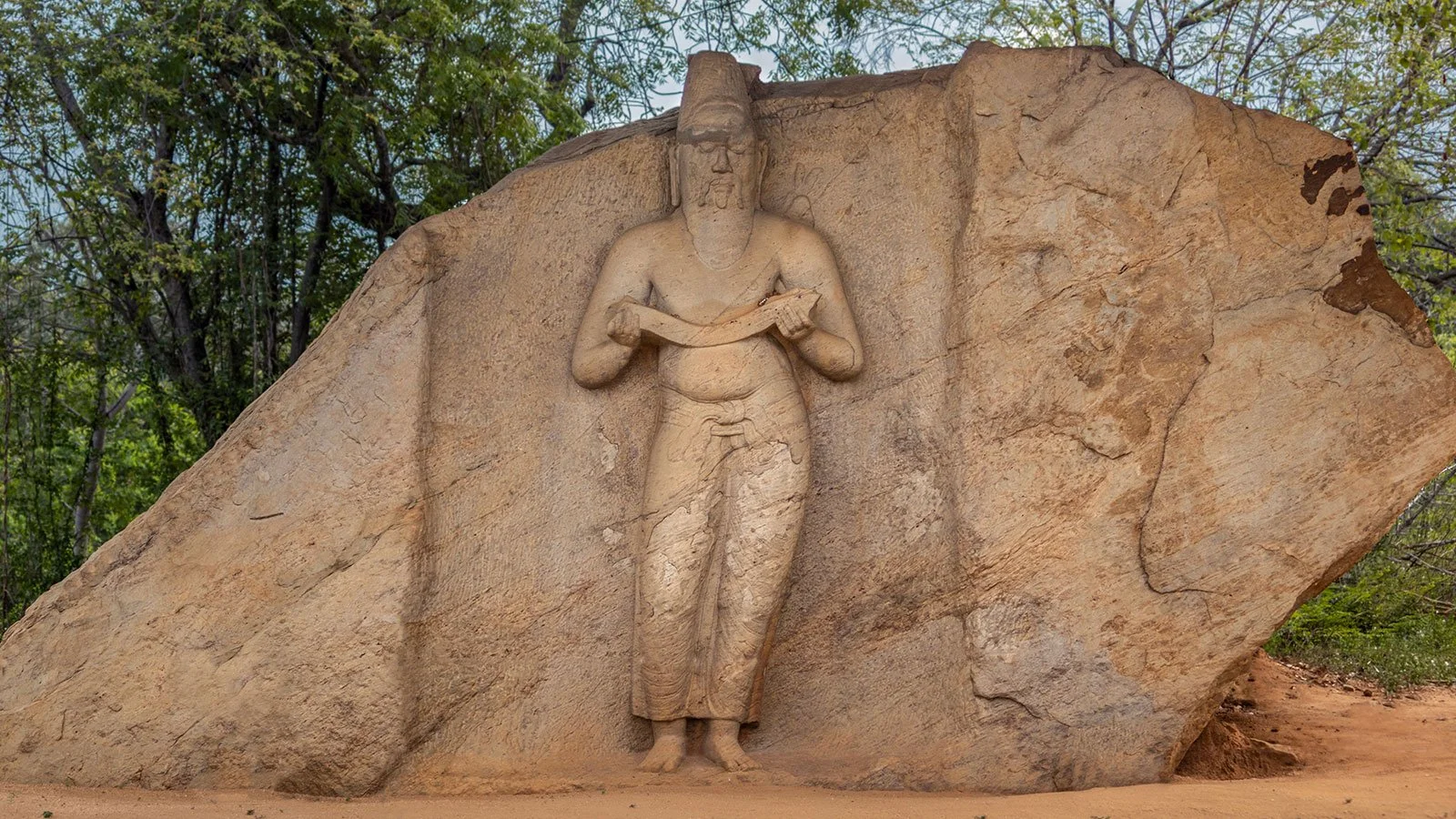
Statue believed to depict either King Parakramabahu I or the sage Agastya, at Potgul Vehera, Polonnaruwa, Sri Lanka.
Where the Tamil South Kept Its Own Medicine
Long before Ayurveda's classical texts had settled into the form we recognize today, a parallel medical tradition was taking shape in the far south of India. It was written not in Sanskrit but in Tamil, credited not to a single sage but to a lineage of adepts, and organized around a diagnostic art so refined that a trained physician could read the nature of an illness through the pulse alone. This is Siddha medicine, and unlike Ayurveda, it never spread widely beyond the region that produced it — it remains, even now, concentrated in Tamil Nadu and parts of Kerala, and in the Tamil-speaking communities of Sri Lanka and Southeast Asia.1
The name comes from siddhi, the word for spiritual accomplishment or perfection. A siddhar is someone who has attained it — traditionally understood as a person who combined the roles of scientist, physician, alchemist, and mystic, and who recorded what they learned in Tamil verse on palm-leaf manuscripts, many of which are still held by families and institutions across Tamil Nadu today.2 Siddha medicine is their legacy — a body of knowledge that treats healing, spiritual attainment, and the search for longevity as facets of the same undertaking.
Eighteen Siddhars and the Science of the Perfected
Tradition counts eighteen siddhars, beginning with Agastya, remembered as the first among them and the one who carried the system south. Some accounts describe Shiva revealing the knowledge to his consort Parvati, who passed it to Nandi, who in turn transmitted it to Agastya and the siddhars who followed.3 Whatever one makes of the origin story, Agastya's centrality is a genuine point of connection to the broader Indian tradition. He is remembered across Indian sources as a bridge between the north and the south, appearing in Ayurvedic and yogic lineages as well as Tamil ones, and he sits within the same wider world of South and Southeast Asian healing figures that gave rise to Thai medicine's founding physician, Jivaka Komarabhacca.
Among the other siddhars, Tirumoolar stands out for the Tirumantiram, a work on yoga, physiology, and the path to long life that is still read as a foundational text of Tamil Shaiva philosophy as well as of Siddha medicine.4 Bogar is remembered for his contributions to alchemy and the preparation of mercury and mineral compounds, and for a tradition — impossible to verify, and worth holding lightly — that credits him with carrying Siddha ideas as far as China.11 These are not simply legendary curiosities. The texts attributed to them, however difficult to date precisely, form the literary backbone that later physicians drew on, and are still drawing on, in Siddha medical colleges today.
A Body Made of Five Elements and Three Humors
Siddha's underlying physiology will feel immediately familiar to anyone who has read our posts on Ayurveda, and that familiarity is not an accident — all three southern traditions inherited a shared vocabulary of the five elements. In Siddha, the body and the universe are both said to arise from earth, water, fire, air, and space, called mann, neer, thee, kaatru, and aakayam, and their interaction produces three governing forces known as the mukkuttram: vatham, which governs movement and the nervous system; pitham, which governs digestion, metabolism, and heat; and kapham, which governs structure, lubrication, and stability.5 Health is the equilibrium of these three, disease is their disturbance.
It is tempting to treat vatham, pitham, and kapham as a simple restatement of the Ayurvedic vata, pitta, and kapha, and the resemblance is real — the two systems clearly share deep roots. But Siddha frames the body's structure differently, describing it in terms of seven physical constituents, the udal thathukkal, rather than Ayurveda's tissue model, and it layers on ninety-six additional principles, the thathuvankal, covering everything from the sense organs to the subtler faculties of mind.6 Where a wellness article will often collapse "Indian traditional medicine" into one undifferentiated system, or use "Ayurvedic" as a loose catch-all for anything from South Asia, Siddha's own textual tradition is explicit that it is a distinct science, with its own founding figures, its own language, and its own diagnostic method.
Reading the Pulse and the Eightfold Examination
That diagnostic method is Siddha medicine's most distinctive contribution, and its most demanding. Physicians are trained in what is called envagai thervu, the eightfold examination: naadi (pulse), sparism (touch), naa (tongue), niram (complexion), mozhi (speech), vizhi (the eyes), malam (stool), and moothiram (urine), which is assessed through two further tests, neerkuri and neikuri, examining the urine's volume, color, and how a drop of sesame oil spreads across its surface.7 Pulse and tongue examination are not unique to Siddha — Ayurvedic and Chinese medicine both rely on them as core diagnostic tools too — but Siddha's framework for reading them, built around vatham, pitham, and kapham rather than the dosha or meridian systems of those neighboring traditions, is entirely its own.
Of the eight, pulse examination carries the most weight. Tamil siddhars are credited as the first in the subcontinent to develop systematic pulse-reading, known as naadi paarththal, as a way of tracing disease back to its source.2 Here is a place where care in language matters. In our earlier post on what the nadis actually are, we drew a firm line between the Ayurvedic sira, physical vessels for blood and other substances, and the yogic nadi, subtle channels for prana belonging to a separate philosophical system. Siddha's naadi occupies its own space again. In clinical practice it refers above all to the three pulses read at the wrist, understood as expressions of vatham, pitham, and kapham, and used diagnostically much the way a physician anywhere might use a pulse to assess a patient — but framed, in the Siddha texts, as a direct reading of the life force moving through the body.7 Three traditions, three related but genuinely distinct ideas, each deserving its own vocabulary rather than a single loose translation.
Alongside the eightfold examination, Siddha physicians historically also relied on manikkadai nool, a wrist-thread measurement used to help time and interpret the pulse reading, and on a formal system for classifying disease itself — the Siddha literature enumerates a traditional total of 4,448 named conditions, organized by cause and presentation rather than by the organ systems familiar to modern biomedicine.7 That scale of classification says something on its own — it reflects centuries of clinical observation compressed into Tamil verse, meant to be memorized and recited by physicians rather than looked up, and it is one more reason Siddha resists being treated as a regional footnote to Ayurveda rather than a complete medical system with its own scope.
Mercury, Muppu, and the Alchemy of Long Life
Siddha medicine is also, unusually among the world's classical systems, an alchemical one in the literal sense. A significant stream of its literature concerns rasavadham, the purification and medicinal use of mercury and other minerals, alongside kayakalpa, a body of practice aimed at rejuvenation and the extension of life.8 Certain substances carry particular weight in this literature — muppu, a "triple salt" prepared through an elaborate purification process, and racamani, a purified mercury compound, are both described as capable of restoring the body and slowing its decline.8 These preparations sit alongside a far larger and more everyday pharmacology of herbal decoctions, medicated oils, and calcined mineral powders that Siddha physicians still prescribe for ordinary complaints.
It would be a mistake to read this alchemical strand as a metaphor dressed up in chemistry, or to read it as chemistry with no metaphor at all. Indian alchemical literature, of which the Siddha tradition is one branch, frames its work around two goals pursued together rather than separately — lohasiddhi, the transmutation of base metal into gold, and dehasiddhi, the perfection of the body itself — treating the physical transformation of a metal as inseparable from the spiritual transformation of the person performing it.9 That double meaning is easy for outside commentary to lose, especially when Siddha alchemy gets summarized in a sentence or two as a historical curiosity rather than engaged with as the coherent, if demanding, discipline its own literature presents it as.
A Living Tradition, Still Practiced and Still Contested
Siddha medicine did not end with the siddhars. It is formally recognized today by India's Ministry of AYUSH, alongside Ayurveda, Yoga and Naturopathy, Unani, and Homoeopathy, and it is taught at the degree level through institutions such as The Tamil Nadu Dr. M.G.R. Medical University, which offers the BSMS (Bachelor of Siddha Medicine and Surgery) and advanced degrees beyond it.10 Registered Siddha physicians can prescribe from the Siddha Pharmacopoeia of India under national drug law, and the system remains the primary form of traditional medicine across Tamil Nadu, with a smaller but real presence among Tamil communities in Sri Lanka, Malaysia, Singapore, and beyond.10
That formal standing does not mean the tradition is uncontested. Questions about the safety of certain mercury- and metal-based preparations, and about the evidentiary basis for specific treatments, are live ones, worth taking seriously rather than waved away in either direction. What is not in question is the coherence and antiquity of Siddha as a medical system in its own right — a Tamil science of the body, built on five elements, three humors, an eightfold diagnostic art, and a literature old enough, and specific enough, to deserve being read on its own terms rather than folded into Ayurveda's larger shadow, or reduced to a single wellness-industry buzzword about "ancient Indian healing."
Siddha's founding figure, Agastya, threads through the broader story of classical Asian medicine we've been tracing — the same wider world that gave rise to Traditional Thai Medicine at the Crossroads of Three Traditions.
Sources
- ↩ Attewell, G. (2008). "Siddha Medicine in Tamil Nadu." Tranquebar Initiative Skriftserie, nr. 04. natmus.dk
- ↩ Wikipedia contributors. "Siddhar." Wikipedia. en.wikipedia.org/wiki/Siddhar
- ↩ "Origin of Siddha, Basic of Siddha." SlideShare. slideshare.net
- ↩ Wikipedia contributors. "Tirumular." Wikipedia. en.wikipedia.org/wiki/Tirumular
- ↩ "Origin and History, Concepts and Principles." Government Siddha Medical College, Chennai. gsmcchennai.ac.in
- ↩ "Overview of Siddha." Vikaspedia, Government of India. vikaspedia.in
- ↩ National Institute of Siddha. "Noi Naadal, the Diagnostic Science of Siddha." nischennai.org. nischennai.org
- ↩ Kędzia, I.B. (2017). "Mastering Deathlessness — Some Remarks on Kaṟpam Preparations in the Medico-Alchemical Literature of the Tamil Siddhas." History of Science in South Asia, 5(2). journals.library.ualberta.ca
- ↩ Sauthoff, P. (2024). "Rasa and Rasaśāstra." Oxford Bibliographies in Hinduism, Oxford University Press. scholars.hkbu.edu.hk
- ↩ Ministry of AYUSH, Government of India (2019). Siddha System of Medicine — The Science of Holistic Health. nischennai.org
- ↩ Wikipedia contributors. "Bogar." Wikipedia. en.wikipedia.org/wiki/Bogar