
Nuad Thai, The Ancient Massage of Thailand, Rooted in Mettā
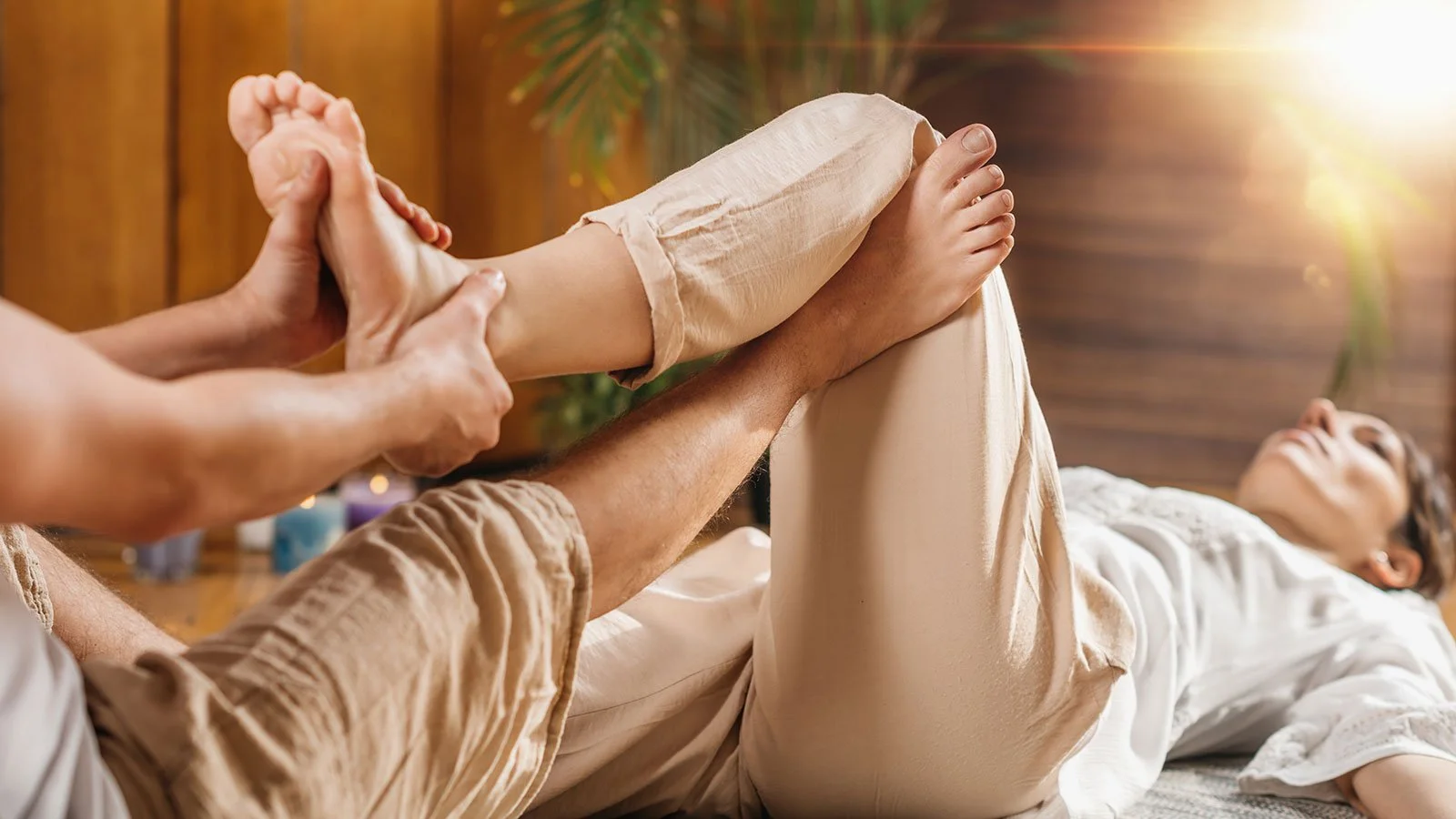
A Thai massage happens on a floor mat, with the receiver fully clothed in loose fabric and no oil in sight. The practitioner leans, presses, and guides the body through slow stretches, breathing in rhythm with the work. It looks nothing like the gliding strokes most of us picture when we hear the word massage. This post explores Nuad Thai, also called Nuad Boran, from what passes between giver and receiver to its roots and its journey to North America.
One Practice, Two Names
In Thailand the practice goes by more than one name. In daily speech it is often called nuad boran, meaning “ancient massage.” The formal name, nuad thai, meaning “Thai massage,” is the one used in the Traditional Thai Medical Professions Act of 2013.1 UNESCO used that same formal name in December 2019, when it inscribed Nuad Thai on its Representative List of the Intangible Cultural Heritage of Humanity.2 The two names describe one practice, one in an official voice and one in a village voice.
UNESCO describes it as a manual therapy in which practitioners use their hands, elbows, knees, and feet, sometimes with warm herbal compresses, to open blockages along the sen, lines understood to crisscross the body, and to bring the four elements of earth, water, wind, and fire back into balance.2 The inscription also traces Nuad Thai to the self-care of farming villages, where each community had its own massage healers.2
What Happens Between Giver and Receiver
Once the receiver lies down, everything begins with the breath. Bob Haddad of Thai Healing Alliance International notes that treatment is enhanced when the receiver is fully relaxed and breathing deeply, while the practitioner uses palms, thumbs, forearms, elbows, knees, and feet to compress, pull, stretch, and rock the body in one continuous flow.3 Thai tradition holds that life is sustained by a vital force, lom, carried along the sen, and that blockages along these pathways give rise to discomfort.3
Before touching the body, many Thai practitioners pause for a moment of silence, thanks, and prayer called the wai khru, a gesture of respect to their teachers and, above all, to Jīvaka Komārabhacca, the Buddha’s physician, whose story we tell elsewhere.4 From there the giving itself becomes the practice. Thai tradition has long understood massage as a physical application of the Buddhist practice of loving-kindness, or mettā, the Pali word for goodwill toward all beings.4,5 Mettā is the first of four brahmavihāras, or immeasurables, alongside compassion (karuṇā), sympathetic joy (muditā), and equanimity (upekkhā).5 Haddad describes breath awareness and focused compassion, when shared by practitioner and receiver, as deepening the whole session.3
Once the work begins, the spirit lives in attention rather than ceremony. One Canadian school describes the pace slowing, movements growing more deliberate, and hands listening as much as pressing.6 The exchange runs both ways. The practitioner offers steady presence, and the receiver offers breath and trust.
Roots in Thailand
Pierce Salguero, a scholar of Buddhist medicine at Penn State Abington,7 notes that many Thais believe Jīvaka, the Buddha’s physician, personally developed massage, though the real transmission of Indian medical knowledge to Thailand was far more complicated.8 The massage practiced today is likely a nineteenth-century synthesis of healing traditions from across the kingdom, blending Indian and Southeast Asian streams of medicine.1 Jīvaka remains its spiritual ancestor. In 1832, King Rama III had surviving medical knowledge carved in stone at Wat Pho in Bangkok, and more than sixty of these epigraphs, showing treatment points, herbal remedies, and energy lines, remain on public display.3 Wat Pho opened its Thai Traditional Medical and Massage School in 1955.1 For the wider medical world this massage belongs to, see our overview of Thai medicine at the crossroads of three traditions.
Northern and Southern Schools
Thai massage is often said to have two schools. The southern style grew largely from the program of study at Wat Pho and emphasizes point pressure along the energy lines, with acupressure protocols and some stretching, and sometimes a cross-fiber plucking of the sen with thumbs and fingers called jap sen. The northern style, practiced in and around Chiang Mai, tends to use palms, thumbs, and feet along the lines, compresses larger areas of the body, and works more deeply with stretching postures.3 A royal style, developed for the king and his family, uses only the hands and keeps a respectful distance from the receiver.3
The Old Medicine Hospital in Chiang Mai describes itself as the birthplace of the northern style, founded in 1962 by Ajahn Sintorn Chaichakan.9 Journalist Perry Garfinkel reports that Sintorn had been among the early teachers of the Wat Pho program before moving north.10 Haddad adds that the styles have blended so thoroughly that telling north from south is now difficult.3 Treat the two schools as descriptions of emphasis rather than sealed lineages.
The Journey to North America
Thai massage reached the West largely through students who traveled to Thailand and brought it home. The pivotal figure was Asokananda, born Harald Brust in West Germany in 1955, who spent most of his time in Asia from 1978 onward studying yoga, Buddhist meditation, and Thai massage.11 He began at the Old Medicine Hospital and went on to study with masters Chaiyuth Priyasith and Pichest Boonthumme.12 In 1990 he published The Art of Traditional Thai Massage in Bangkok, the first book on the subject not written in Thai, and he opened a school in a Lahu hill-tribe village north of Chiang Mai.13
Asokananda founded the Sunshine Network, a loosely connected community of teachers now headquartered in a Lahu village in northern Thailand, with most of its teachers in Europe.14 He died in June 2005.11 He favored the name Thai Yoga Massage, drawn by parallels between the Thai sen lines and the nadis of yoga, and between Thai stretches and yoga postures.14 The name spread widely, though it was coined by Western practitioners and is not used in Thailand.15
On this continent the story runs through two lines of teaching. The first begins with Kam Thye Chow (1958–2018), who studied beside Asokananda for six years and founded the Lotus Palm School in Montreal in 1995, which the school calls the first institution in North America dedicated to Thai yoga massage.16 In 1995, he later wrote, he seemed the only one teaching the art on the East Coast, and by 2011 most spas offered it and every major city had a teacher.17 It continues with Shai Plonski, a senior student of Chow’s and former Lotus Palm dean, who has since begun his own school in California, the Still Light Center.18,19 The second runs through Bob Haddad, who began studying in 1999, counts Asokananda and Ajahn Pichest Boonthumme as key influences, and in 2005 founded Thai Healing Alliance International, which recognized practitioners meeting basic standards of study and practice.20,1
Demand has grown on both sides of the Pacific. Garfinkel reported in 2008 that the Old Medicine Hospital’s director had watched yearly foreign enrollment climb from about twenty students to four hundred over two decades, with most students now coming from the West.10 Salguero recalled that when he first studied in Chiang Mai in 1997 there were four or five schools, and by 2008 there were about thirty.10
Holding the Tradition Honestly
Haddad observes that since the 1990s Thai massage has often been hybridized with other therapies, and he cautions against diluting a system whose strength lies in its long history.3 Salguero, speaking to Garfinkel in 2008, called the attention Thai medicine now receives a double-edged gift, renewing relevance and preserving practices while risking the flattening of regional village knowledge.10
A few distinctions deserve some care. Thai Yoga Massage is a useful Western name, not a Thai one. The sen echo yogic nadis and Chinese meridians in ways that fascinate practitioners, but they belong to their own tradition and vocabulary, and UNESCO describes them as lines the tradition understands to run through the body rather than as anatomical structures.2 Massage of any kind can support relaxation and short-term relief, and claims beyond that tend to outrun the evidence.1
Receiving Nuad Thai Today
If you feel drawn to receive Thai massage, ask your practitioner where they trained and whom they studied with. A good teacher will be glad to name their lineage, whether Wat Pho, Chiang Mai, the Sunshine Network, or a North American school. Come dressed comfortably, breathe slowly, and tell your practitioner what feels good and what does not. Something older than any marketing story is happening in the room, one person offering attentive care to another.
From Healing Hands to Healing Stone
Healing in Buddhist Asia has other faces too. The Medicine Buddha, Bhaiṣajyaguru, is named in his sutra as the Medicine Guru, King of Lapis Lazuli Light, and most translators render his radiant stone, vaiḍūrya, as lapis lazuli.21 In Buddhist art, the deep blue of that stone is almost always part of his image.22 Why a stone became the color of healing is where our next series on stone medicine begins.
Our Stone Medicine series opens with lapis lazuli, the deep blue stone of the Medicine Buddha named in Jīvaka Komārabhacca and the Physician Behind Thailand’s Healing Arts.
Sources
- ↩ Wikipedia contributors. “Traditional Thai massage.” Wikipedia. en.wikipedia.org/wiki/Traditional_Thai_massage
- ↩ UNESCO. (2019). “Nuad Thai, traditional Thai massage.” Intangible Cultural Heritage, Representative List. ich.unesco.org/en/RL/nuad-thai-traditional-thai-massage-01384
- ↩ Haddad, Bob. “An Overview of Traditional Thai Massage.” Thai Healing Alliance International. thaihealingalliance.com/wp-content/uploads/An-Overview-of-Traditional-Thai-Massage.pdf
- ↩ “Thai Massage, Loving Kindness, and Spiritual Awareness.” Traditional Bodywork. traditionalbodywork.com/the-true-spirit-of-traditional-thai-massage-in-thailand
- ↩ “Metta and Karuna in Theravada Buddhism, Thailand, and Thai Traditional Medicine.” Traditional Bodywork. traditionalbodywork.com/metta-loving-kindness-in-the-thai-healing-arts
- ↩ “The Relation Between Buddhist Teachings and Thai Massage.” Sirius Health Thai Massage School, Saskatoon. thaimassage.school/learning/buddhist-teachings-and-thai-massage
- ↩ “Pierce Salguero.” Penn State Abington. abington.psu.edu/person/pierce-salguero
- ↩ Salguero, C. Pierce. “Jivaka Komarabhacca.” Thai Healing Alliance International. thaihealingalliance.com/pdf/Jivaka_essay.pdf
- ↩ Old Medicine Hospital Thai Massage School Shivagakomarpaj. “Welcome.” oldmedicine.org
- ↩ Garfinkel, Perry. (2008). “Thailand Reclaims Its Ancient Medicinal Roots.” Massage & Bodywork. massagetherapy.com/articles/thailand-reclaims-its-ancient-medicinal-roots
- ↩ “Asokananda.” Sunshine Network. asokananda.com/asokananda.html
- ↩ “Asokananda — No Night in Freedom.” Sunshine House Greece. thaimassage.gr/blog/asokananda-no-night-in-freedom
- ↩ “About Thai Yoga Massage.” Sunshine Network Austria. thaiyogamassage.at/about-tym
- ↩ “Thai Yoga Massage and the Sunshine Network.” Traditional Bodywork. traditionalbodywork.com/sunshine-network-review
- ↩ “What Do the Many Exotic Names for Thai Massage Really Mean?” Thai Healing Massage. thaihealingmassage.com/why-are-there-so-many-names-for-thai-massage
- ↩ “Kam Thye Chow, Founder of Lotus Palm School, 1958–2018.” Lotus Palm School. lotuspalm.com/about-our-founder
- ↩ Chow, Kam Thye. (2011). Advanced Thai Yoga Massage: Postures and Energy Pathways for Healing. Healing Arts Press. everand.com/book/351488164
- ↩ “Shai Plonski.” Kripalu Center for Yoga & Health. kripalu.org/people/shai-plonski
- ↩ Kern, Shama. “Thai Massage Interview With Shama Kern and Shai Plonski.” Thai Healing Massage Academy. thaihealingmassage.com/thai-massage-interview-with-shama-kern-and-shai-plonski
- ↩ Haddad, Bob. “The Teacher.” ThaiHealing-Arts.com. thaihealing-arts.com/about-bob
- ↩ Wikipedia contributors. “Bhaisajyaguru.” Wikipedia. en.wikipedia.org/wiki/Bhaisajyaguru
- ↩ “Bhaisajyaguru — The Medicine Buddha.” Learn Religions. learnreligions.com/bhaisajyaguru-the-medicine-buddha-449982