
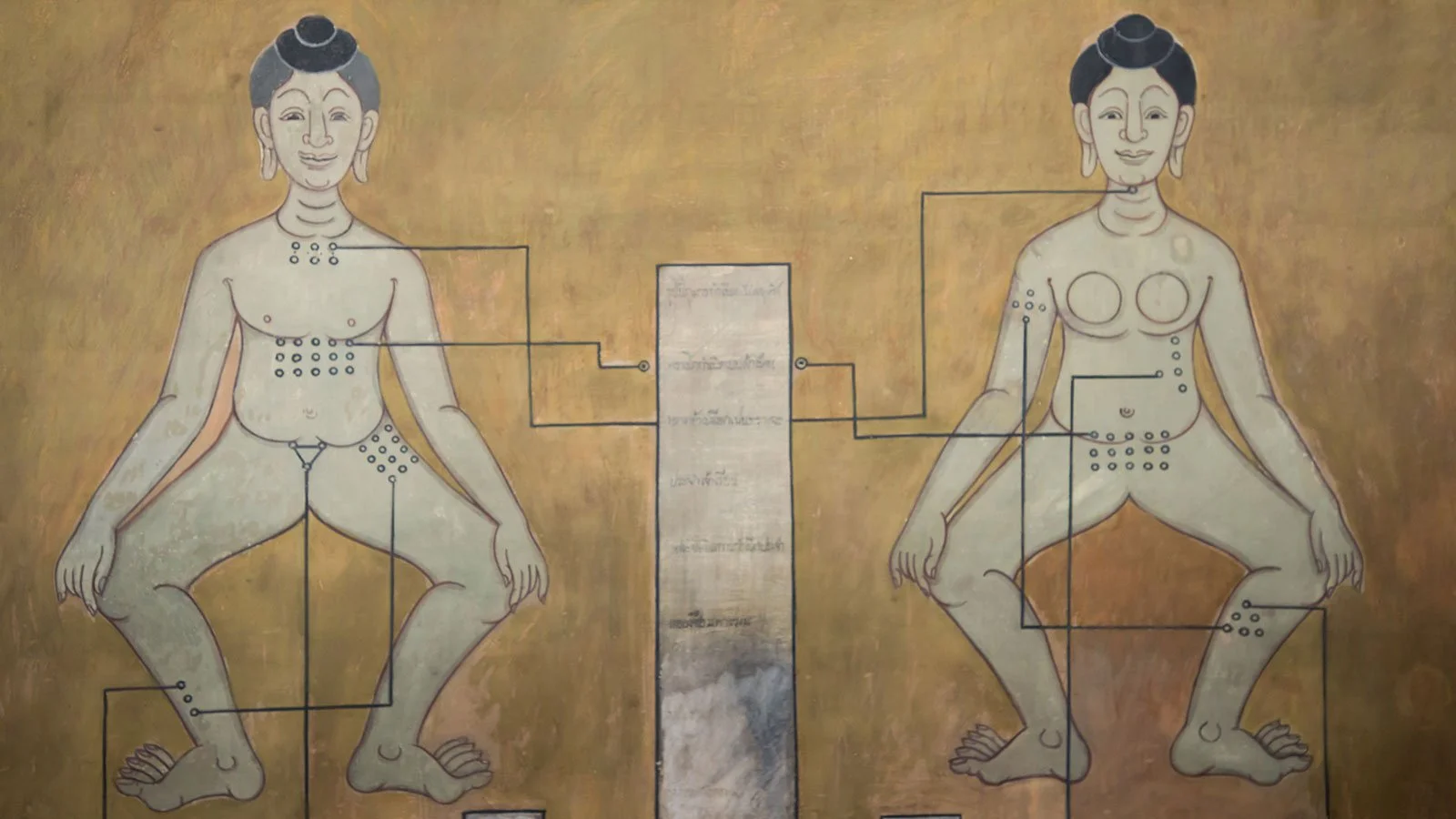
Traditional sen-point chart from Wat Pho, Thailand's temple of the reclining Buddha and the historic home of Thai massage instruction.
A Medicine Built at a Crossroads
Traditional Thai medicine carries the fingerprints of at least three older traditions — Indian, Chinese, and the indigenous animist and Buddhist practices of the Southeast Asian mainland — folded together over centuries into something distinctly Thai. Practitioners still trace its lineage back to a single revered figure, Jīvaka Komārabhacca, honored across Thailand as the "Father Doctor" and physician to the Buddha himself1. He lived and practiced in India in the 5th century BCE, trained at the great medical university of Takṣaśilā, and never appears in any historical account as having traveled to what is now Thailand2. His story deserves its own telling — we'll turn to it properly in an upcoming piece — but for now it's enough to know that his memory, carried outward by Buddhist monastic networks centuries before there was a Thailand to receive it, became the symbolic root from which this whole system grew.
What that system produced is a coherent, still-practiced medicine with its own theory of the body, its own diagnostic logic, and its own manual therapy — Nuad Thai, or traditional Thai massage — that has outlasted empires, survived the fall of a capital city, and is still taught today largely as it was centuries ago.
Four Elements and Forty-Two Parts
Classical Thai medical theory holds that the human body is composed of forty-two elements, distributed across four broader groups — earth, water, wind, and fire. Health depends on keeping these elements in balance; illness is what happens when one or more falls into disorder. A traditional physician's task was less about naming a disease in the Western sense and more about diagnosing which elements had gone out of balance, and why, then working to restore equilibrium between them3. Later Thai medical writing sometimes frames this balance as a "circle of life" — three essences of body, mind, and energy that must stay in harmony for a person to remain well2.
Moving through and animating these elements is a network of invisible channels called sen — not blood vessels or nerves, but pathways for life force, or lom. Historical manuscripts and the temple murals of Wat Pho in Bangkok map out ten principal sen lines, chosen because working them is considered sufficient to influence the whole body. A practitioner applies acupressure along these lines and at specific points, guiding a client through assisted stretches that echo yoga postures — all without oil, and traditionally performed through loose clothing4.
The sen system openly borrows the language of Indian yogic nadis, and some of its acupressure points are discussed alongside Ayurvedic marma points5. But sen are not a simple copy of either system — they're a Thai synthesis, shaped by centuries of contact with Indian, Chinese, and Khmer medicine, then filtered through Buddhist cosmology into something with its own logic.
More Than a Physical Complaint
Classical Thai medicine has never treated the body as a closed system. Its manuscripts describe disease as arising not only from elemental imbalance but from a person's relationship with their wider world — social tension, conduct, and the spirit realm all had a bearing on health, and a traditional diagnosis might weigh a patient's history and family circumstances as carefully as their physical symptoms3.
This holistic view shows up practically in the range of specialties that grew up alongside massage. The broader canon of Thai medical manuscripts covers herbal pharmacology (tamra ya samunphrai), with detailed recipes for preparing medicinal plants ranging from common kitchen herbs to rarer forest botanicals, alongside entirely separate manuals for midwifery — both drawing on knowledge accumulated by generations of royal court physicians3. Herbal medicine, massage, and what might be called ritual or spirit practice were never fully separated in the classical texts. They were different tools brought to bear on the same underlying goal of restoring balance, chosen according to what a particular patient and a particular imbalance called for.
Preserved Through Royal Patronage
This body of knowledge did not simply survive on its own — it was actively gathered, tested, and re-gathered by successive royal courts. During the Ayutthaya period, King Narai commissioned the Tamra Phra Osot Phra Narai, the first known Thai royal pharmacopeia, compiled by court physicians and drawing on Thai, Chinese, and Western medical knowledge circulating through Ayutthaya's busy foreign trade3.
When Ayutthaya fell in 1767, a great deal of that accumulated knowledge was lost along with the city. The task of rebuilding fell to the new Chakri dynasty in Bangkok. King Rama I had medical formulas and body-stretching postures inscribed on the walls of the newly renovated Wat Pho monastery and established a royal Department of Pharmacy to oversee official medicine procurement, much as had existed under Ayutthaya; King Rama II gathered practitioners from across the kingdom to resubmit their formulas after another devastating epidemic; and King Rama III, between 1831 and 1841, commissioned an enormous public reference project — 1,431 inscribed stone slabs covering history, literature, ethics, and medicine, installed across the walls of Wat Pho's buildings. Of those, more than 600 slabs are given over to medical texts, still among the most complete surviving collections of classical Thai medical writing6.
The choice to inscribe this knowledge in a public monastery, rather than keep it within court or family lineages, was deliberate. Wat Pho was intended to function as an open school, free for ordinary people to study — a design historians have since called Thailand's first open university6. That commitment to public transmission is part of why the tradition survived intact enough, more than a century later, to be recognized on the world stage — a rare case of medical knowledge being preserved precisely because it was made freely available rather than guarded. Its more recent history has not been a straight line, though — the rise of Western biomedicine pushed the classical system toward the margins through the early twentieth century, and it was public health revival efforts, along with a practical return to herbal medicine during wartime shortages, that kept it from disappearing altogether7.
Nuad Thai as Living Heritage
Nuad Thai, or traditional Thai massage, is the clinical expression of everything above: a practitioner working along the sen lines with rhythmic acupressure, guiding a client through assisted stretches drawn from yogic postures, done fully clothed and without oil, to restore the free flow of lom through the body.
In December 2019, Nuad Thai was formally recognized by UNESCO as an element of the Intangible Cultural Heritage of Humanity. The inscription describes it plainly: a non-medicinal manual therapy in which the practitioner works to rebalance a patient's body, energy, and structure by addressing blockages along the sen, with the aim of normalizing the four elements8.
The announcement was made at Wat Pho itself, where Dr. Pramote Satianrat of Thailand's Department of Thai Traditional and Alternative Medicine credited decades of documentation and teaching for preserving the practice well enough to meet UNESCO's standard9. Thailand also gives the tradition formal legal standing today: the Traditional Thai Medical Professions Act of 2013 defines and regulates it as a recognized field of practice, distinct from — but coexisting alongside — conventional biomedicine4.
Two Threads Still to Follow
This overview only gestures at what's really a rich, layered tradition, and there are two threads worth pulling further. The first is Jīvaka himself — who he actually was, what the historical record supports versus what centuries of devotion have added, and how a physician who likely never set foot in Thailand became its founding figure. The second is Thai massage itself — the practice as it's actually performed, the reasoning a skilled practitioner draws on case by case, and the deeper anatomy and philosophy behind the assisted stretches and pressure work — together, they'll round out a fuller picture of a tradition that runs far deeper than this overview alone can show.
This piece continues threads from our foundational post on Ayurveda and the knowledge of life and our exploration of marma points and the places where life gathers — each tradition mapping the space between body and spirit in its own way.
Sources
- ↩ "Jīvaka," Wikipedia, en.wikipedia.org/wiki/Jīvaka.
- ↩ Pierce Salguero, "Jivaka Komarabhacca," Thai Healing Alliance International, thaihealingalliance.com.
- ↩ "Thai massage in the early 19th century," Asian and African Studies Blog, British Library, blogs.bl.uk.
- ↩ "Traditional Thai massage," Wikipedia, en.wikipedia.org/wiki/Traditional_Thai_massage.
- ↩ "What Are Sen Sib?" Sirius Health Thai Massage School, thaimassage.school.
- ↩ "Chakri Dynasty and Thai Public Health," Health Information System Development Office, hiso.or.th.
- ↩ "Thai Traditional Medicine," May Term Thailand, maytermthailand.org.
- ↩ "Nuad Thai, traditional Thai massage," UNESCO Intangible Cultural Heritage, ich.unesco.org.
- ↩ "Unesco lists Nuad Thai as an 'intangible cultural heritage,'" Bangkok Post, bangkokpost.com.