
Jīvaka Komārabhacca and the Physician Behind Thailand's Healing Arts
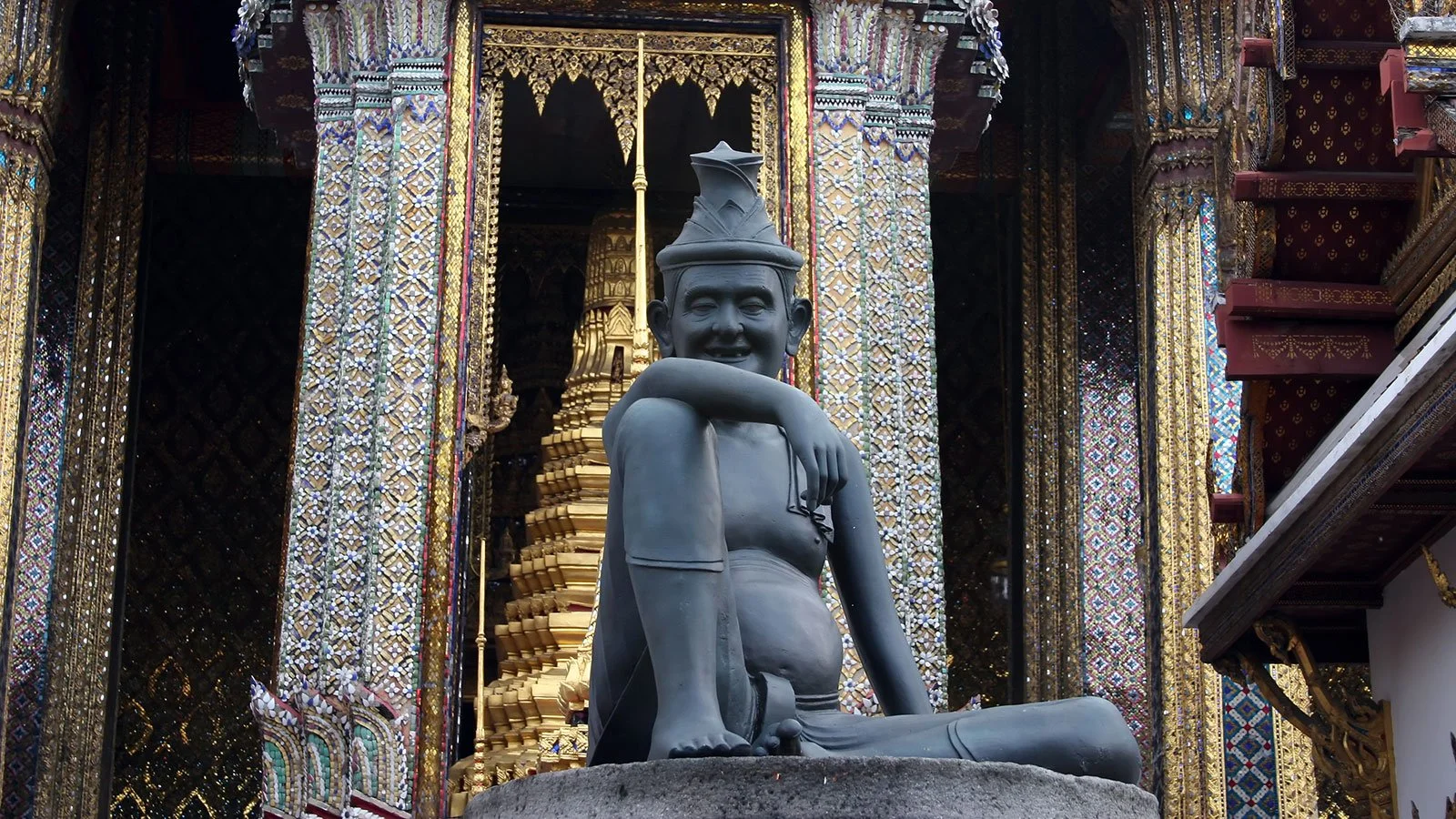
In an earlier piece on Thai medicine, we described the tradition as one built at a crossroads — a body theory borrowed from India's humoral medicine, exercises drawn from yogic postures, and a spiritual dimension shaped by Buddhism. Nearly every account of that meeting point begins with the same figure: a physician neither born a prince nor trained in Thailand, yet revered across the peninsula as the founder of its healing arts. His name was Jīvaka Komārabhacca, and he lived, by most accounts, in the fifth century BCE.1 Separating what the Pāli Canon actually records about him from what devotion, legend, and modern wellness marketing have layered on since is itself a worthwhile study in how a tradition remembers its origins.
A Name Given Before His Identity Was Known
The earliest and most detailed account of Jīvaka's life appears in the Mahāvagga section of the Vinaya Piṭaka, the monastic code of the Pāli Canon compiled in the centuries following the Buddha's death. According to this account, Jīvaka was born to Sālavatī, a courtesan of Rājagaha, and abandoned shortly after birth, wrapped in cloth and left on a rubbish heap. He was found and adopted by Prince Abhaya, a son of King Bimbisāra of Magadha.2 When attendants were asked whether the infant still lived, they answered jīvati, "he lives," and the name stuck. The second half of his name, Komārabhacca, records that he was reared by a prince, kumārena posāpito, though some later commentators read it instead as a term for the pediatric branch of Indian medicine, kaumārabhṛtya, a specialty concerned with the care of infants and children.3 As a young man, Jīvaka learned of his origins from playmates who teased him for having no known mother. Rather than shrink from this, the Pāli account frames it as the moment that pointed him toward medicine, and a wish to become, in his own words, a preserver of life rather than a beneficiary of royal favor he had not earned.
Seven Years at Takkasilā
Without his adoptive father's knowledge, Jīvaka traveled to Takkasilā, in what is now northern Pakistan, a center of learning known throughout the ancient world and a destination for students of medicine, grammar, and statecraft alike. He apprenticed there for seven years under a teacher the Pāli sources leave unnamed, though later Sanskrit, Tibetan, and Thai retellings each supply a different name for him — a reminder that as Jīvaka's story spread across Asia, each culture filled in what the earliest canon had left open, shaping the story to its own lineage of teachers.4 When his training ended, his teacher judged him fit to practice, gave him a small sum of money, and sent him on his way with no further instruction, a test in itself of whether his years of study had taken root. His first case, taken on the road home, was the wife of a wealthy merchant in Sāketa who had suffered from headaches for seven years, a condition earlier physicians had been unable to resolve. His treatment worked, and he was paid sixteen thousand kahāpaṇas along with a manservant, a maidservant, and a horse-drawn carriage — a windfall that established his reputation before he had even reached home.5
Physician to a King, and to the Buddha
Back in Rājagaha, Jīvaka's reputation grew quickly. He cured King Bimbisāra of a chronic fistula and was rewarded with ornaments from the royal household, then formally appointed physician to the king, to the women of the court, and, at Bimbisāra's request, to the Buddha and his community of monks. The canon credits him with several notable cases, including a trepanning operation on a merchant of Rājagaha suffering from a cranial ailment, and treating the Buddha himself for an imbalance of the doṣas — the humoral categories of wind, bile, and phlegm that Thai and Ayurvedic medicine both inherited from classical Indian physiology.6 Jīvaka's reasoning throughout these episodes reflects that same humoral framework — heat, cold, and the balance of bodily constituents — rather than the language of channels, spirits, or subtle energy that later folk traditions layered onto his story. The canon also notes that Jīvaka's workload, spread across the palace, the merchant class of Rājagaha, and the entire monastic order, eventually outpaced what one physician could manage, a detail that speaks as much to his renown as to the demand for skilled medical care in the period.
The Mango Grove He Gave Away
Jīvaka's devotion to the Buddha grew alongside his medical fame. Finding the existing monastery at Veḷuvana too far to visit twice daily, he donated his own mango grove, the Jīvakārāma, as a residence for the Buddha and the sangha, a gift the texts describe in some detail as it became a recognized retreat site during the rainy season.7 It was Jīvaka, the texts say, who persuaded the Buddha to let monks accept donated robes rather than sew garments exclusively from discarded cemetery cloth, having noticed as a physician how often that practice contributed to his patients' skin ailments and general poor health. He is also credited with urging monks to take regular exercise, after observing their pale, unhealthy appearance during his travels to Vesāli on business.8 Jīvaka himself became a sotāpanna, a stream-enterer on the Buddhist path, while remaining a layperson rather than ordaining — he told the Buddha directly that he preferred to stay free to treat the sick rather than take on a monk's restrictions.
From Rājagaha to Wat Pho
None of what follows appears in the Pāli Canon. It belongs to the centuries of transmission that carried Jīvaka's memory out of India and into Southeast Asia alongside Buddhism itself, absorbing local practice as it traveled. In Thailand, where he is known as Shivago Komarpaj, Jīvaka is honored as the founding figure of traditional Thai medicine and of Nuad Thai, Thai massage, and practitioners traditionally open a treatment with a wai khru, a gesture of respect to him as teacher, before beginning work — a living ritual that ties a contemporary treatment room back to a physician who practiced some twenty-five centuries earlier. Stone inscriptions from the Sukhothai kingdom under King Ramkhamhaeng, dating to the late thirteenth century, already reference the herbal knowledge associated with this lineage, evidence that his reputation had taken root in Thailand well before the Bangkok era.9 Centuries later, King Rama III ordered the compilation of Thai massage and medical knowledge onto stone tablets at Wat Pho in Bangkok, along with statues depicting the ascetic hermit stretches, rusee dat ton, attributed to Jīvaka's circle, establishing what became the Wat Pho Traditional Medical School. Historical practice at Wat Pho distinguished a formal Royal Court style, performed with hands and fingers only for nobility, from a more physically expansive Commoner style practiced more broadly among ordinary people, a division that echoes the split we noted in our earlier post between palace-preserved and orally transmitted branches of Thai medicine.10
One Figure, Not to Be Mistaken for Another
Because Jīvaka's reputation traveled so widely, it is worth being precise about who he was not. Vajrayāna Buddhism venerates a separate healing figure, Bhaiṣajyaguru, the Medicine Buddha — a celestial buddha belonging to an entirely different order of being, not a historical person who trained at Takkasilā and treated real patients in Rājagaha.11 Wellness marketing sometimes blurs the two, treating Jīvaka as a kind of universal medicine-buddha archetype rather than the historical physician the Pāli Canon actually describes, or crediting him with an unbroken chain of secret energetic techniques the earliest sources never mention. The distinction matters for the same reason distinguishing nadi from sira mattered in our earlier writing on the subtle body — conflating a documented lay physician with a celestial buddha from a different tradition does not honor either lineage, it flattens two separate stories into one marketable image, and it obscures what actually makes Jīvaka's story worth telling.
What the earliest sources actually preserve is, if anything, more compelling than the legend. Not a mythic founder handing down secret energy work, but a working doctor, trained through years of ordinary apprenticeship, who built his reputation one difficult case at a time. His court cases, his surgical interventions, and even his practical advice about laundry and exercise became foundational enough that an entire medical tradition, carried across a continent and through twenty-five centuries, still opens its sessions with a gesture of thanks in his name.
A Physician, Not a Symbol
That gesture points to something more specific than reverence alone. Jīvaka's statue appears today in temples, massage schools, and increasingly in spas and yoga studios far from Thailand, often stripped of any context beyond a vague sense of ancient wisdom. But the record the Pāli Canon preserves describes something more specific and, in its way, more useful to practitioners now: a physician who apprenticed for years before treating a single patient, who was paid fairly and generously for skilled work, who used surgery when surgery was called for and humoral reasoning when it was not, and who never stopped treating the poor even as his fame grew. That is a more demanding standard to hold than reverence for a symbol, and it shows up less in the statues than in the hands-on work still carried out in his name, one stretch, one pressure point, one session at a time.
Jīvaka's story is the living root of the tradition traced in our earlier piece on Thai medicine at the crossroads of three traditions, and it's the ground we'll return to soon in a closer look at Nuad Thai itself.
Sources
- ↩ "Jīvaka." Wikipedia. en.wikipedia.org/wiki/Jīvaka
- ↩ "Abstracts of Buddhist Medical Sources in Pāli," citing I.B. Horner (trans.), The Book of the Discipline, Vol. IV, Mahāvagga 8.1.1–36. asianmedicinezone.com
- ↩ Malalasekera, G.P. Dictionary of Pāli Proper Names, "Jīvaka." palikanon.com
- ↩ Salguero, C. Pierce. "Jivaka Komarabhacca." Thai Healing Alliance. thaihealingalliance.com
- ↩ Malalasekera, G.P. Dictionary of Pāli Proper Names, "Jīvaka." palikanon.com
- ↩ "Abstracts of Buddhist Medical Sources in Pāli," citing I.B. Horner (trans.), The Book of the Discipline, Vol. IV. asianmedicinezone.com
- ↩ Salguero, C. Pierce. "Jivaka Komarabhacca." Thai Healing Alliance. thaihealingalliance.com
- ↩ "The Story of Jivaka, the Buddha's Personal Physician." Buddhistdoor Global. buddhistdoor.net
- ↩ "Nuad Thai: Thai Massage – a UNESCO Intangible Cultural Heritage." Thailand Foundation. thailandfoundation.or.th
- ↩ "Thai Massage Revealed: Ancient Medical Science That Stands the Test of Time." Chulalongkorn University. chula.ac.th
- ↩ Journal of the International Buddhist Studies College, on Jīvaka Komārabhacca and Bhaiṣajyaguru as distinct healing figures in Theravāda and Vajrayāna tradition. so03.tci-thaijo.org