
The Medicine Buddha and the Road from Sutra to Clinic
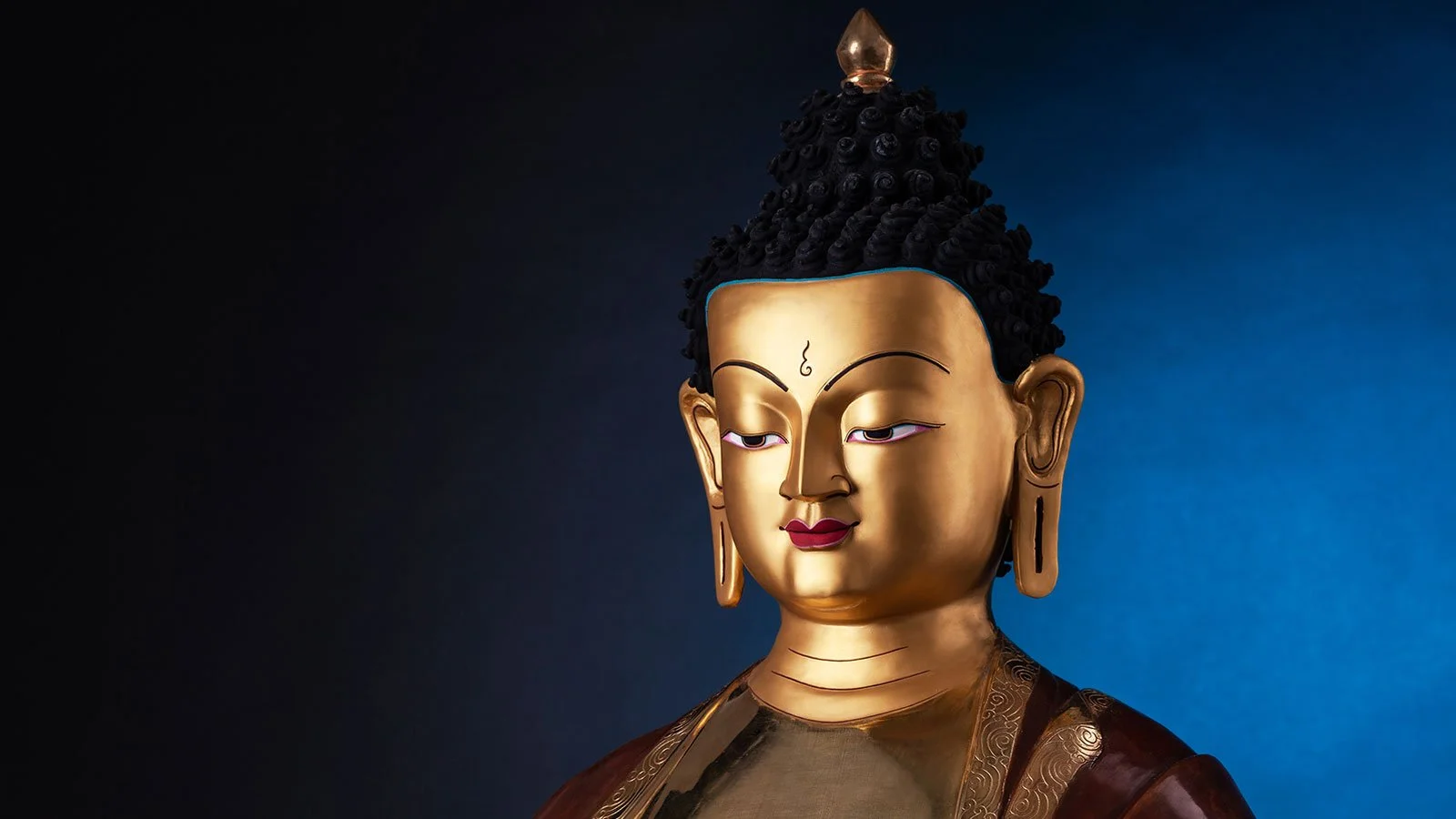
The Medicine Buddha, King of Lapis Lazuli Light, in gilded stillness.
Across the Buddhist cultures of Asia, one figure sits where medicine and liberation meet. He is seated in monk’s robes, his body the deep blue of lapis lazuli, a bowl of medicine resting in his left hand and a sprig of myrobalan held lightly in his right. In Sanskrit he is Bhaiṣajyaguru (भैषज्यगुरु), the Medicine Guru; in Tibet he is Sangye Menla (སངས་རྒྱས་སྨན་བླ), in China Yaoshi Fo (藥師佛), in Japan Yakushi Nyorai (薬師如来).1 For some fifteen hundred years people have prayed to him for relief from fever, blindness, famine, and early death, and Tibetan physicians go further still, naming him the teacher of their entire medical system. To follow him is to watch a single sacred image carry a whole theory of healing across a continent.
In This Article
- A Buddha Named for a Stone
- The Sutra Behind the Image
- Twelve Vows, Read Closely
- Lamps, Banners, and Temples
- The Teacher of Tibetan Medicine
- A Rattle in Thailand
- Where Illness Begins in the Mind
A Buddha Named for a Stone
His full title, Bhaiṣajya-guru-vaiḍūrya-prabha-rāja, is usually rendered Medicine Guru, King of Lapis Lazuli Light.1 That translation ties him directly to the stone we followed out of the mountains of Badakhshan in lapis lazuli and the long memory of stone medicine. The word underneath it is less settled than the translation suggests. Vaiḍūrya (वैडूर्य) names a precious blue stone, and the scholar Marianne Winder argued that it originally meant beryl rather than lapis.2 Tibetan authors seem to have lived comfortably with both readings. The great seventeenth-century commentary on their medical canon is titled Vaiḍūrya Ngönpo, known in English as the Blue Beryl.3
In practice the question matters less than it seems. Whatever stone the earliest authors had in mind, the tradition settled on a deep, luminous blue, and that blue became inseparable from the figure. His eastern pure land is named for it, his body is painted in it, and the sutra describes his aura as its light.1
The Sutra Behind the Image
Nearly everything we know about the Medicine Buddha comes from one scripture, the Bhaiṣajyaguru Sūtra. It opens in the city of Vaiśālī, where the bodhisattva Mañjuśrī asks the historical Buddha to describe the names and past aspirations of other buddhas, and the benefits that come from hearing them.4 Sanskrit manuscripts of the text discovered at Gilgit, in present-day Pakistan, and at Bamiyan in Afghanistan confirm that it circulated in the Buddhist northwest of the Indian world.5
In China the story is more tangled. Four translations survive in the canon, and the two most widely recited come from the pilgrim-monk Xuanzang in 650 and from Yijing in 707, whose longer version adds six more healing buddhas to make a group of seven.1 The earliest Chinese version is harder to place. Though traditionally credited to a fourth-century translator, it was listed by the early catalog of Sengyou as a suspect text, compiled around 457 by a monk named Huijian.5 The scholar Michel Strickmann argued that the larger collection it belongs to, the Consecration Sūtra, drew on Daoist ritual models.6 The Sanskrit manuscripts have since reopened that debate, and the text’s history remains an open question.5
Twelve Vows, Read Closely
At the heart of the sutra are twelve vows the Medicine Buddha made as a bodhisattva, long before his awakening. Only a few concern illness in the narrow sense. He vows that those born with impaired bodies will be made whole, and that the sick who have no doctor, no medicine, and no one to care for them will find relief on hearing his name. The rest reach much further. He vows to feed the hungry, clothe the poor, free prisoners, turn those on mistaken paths toward awakening, and help people restore the precepts they have broken.1 One vow, that women who wish it may be reborn as men, reflects the gender assumptions of its era, and modern paraphrases often soften its wording.
Read as a whole, the vows describe illness as one strand in a wider fabric of suffering that includes hunger, poverty, captivity, and moral confusion. The Medicine Buddha tends to all of it, and the final medicine he offers is awakening itself.4
Lamps, Banners, and Temples
The sutra also prescribes ritual. Xuanzang’s version became the basis of a rite in which temples light forty-nine lamps and keep them burning without interruption, hang five-colored banners, and recite the sutra throughout the ritual period. The practice was already in use in the early Tang dynasty, and because it was so often performed for longevity, the lamps came to be called long-life lamps. Chinese monasteries still hold these rites, especially in the eighth lunar month.1
In Japan the Medicine Buddha arrived through the ruling house. According to the Nihon Shoki, Emperor Tenmu commissioned the temple of Yakushi-ji (薬師寺) in 680 as an offering for the recovery of his consort, the future Empress Jitō, and after he ordered one hundred monks ordained on her behalf, she recovered.7 The temple’s great triad, with Yakushi seated between the bodhisattvas of sunlight and moonlight, remains one of the treasures of Japanese Buddhist art.8 Healing here was communal and political as much as personal. A ruler’s prayer for his wife was also an act of state, carried out in bronze and in the ordination of monks.
The Teacher of Tibetan Medicine
Nowhere does the Medicine Buddha carry more weight than in Sowa Rigpa, the Tibetan science of healing. Its foundational text, the Gyüshi (རྒྱུད་བཞི) or Four Tantras, is traditionally held to have been taught by the Buddha in the form of the Medicine Buddha.9 In the text’s own framing, the teaching unfolds in Tanaduk, a city of medicine set within a mandala of healing mountains. A sage named Rigpe Yeshe emanates from the Medicine Buddha’s heart to deliver the teaching, and a second sage, Yilekye, emanating from his tongue, bows and requests it.10
Historians trace the text as practiced today to the twelfth-century edits of the physician Yuthok Yönten Gönpo the Younger,11 whom the tradition honors as an emanation of the Medicine Buddha.9 The Four Tantras absorbed a great deal of Indian medicine along the way, drawing especially on Ayurveda and Vāgbhaṭa’s Aṣṭāṅga Hṛdaya.12
The Buddhist framing is doctrinal, not decorative. The Four Tantras trace the three nyes pa, the bodily faults of wind, bile, and phlegm, back to the three poisons of Buddhist thought. Attachment gives rise to wind, anger to bile, and ignorance to phlegm, and beneath all three lies a more basic ignorance about the nature of the self.13 A Tibetan physician treating a digestive complaint is working, at least in theory, at the far end of a chain that begins in the mind.
In the late seventeenth century, the regent Desi Sangye Gyatso composed the Blue Beryl commentary and commissioned a celebrated set of medical paintings to illustrate it, begun around 1687. The paintings present the Medicine Buddha as the teacher who expounds the Tantras, the source from which the whole visual encyclopedia of anatomy, diagnosis, and pharmacology unfolds.14
A Rattle in Thailand
The Medicine Buddha also appears in Theravada Thailand, where Mahayana buddhas otherwise play a small formal role. The Phra Kring, a metal image made only in Thailand, is understood as a form of the Medicine Buddha. Many contain a loose bead that rattles when the image is shaken, said to sound out his name.1 It is a small, tactile echo of the sutra’s promise that hearing the name alone brings relief. It sits beside Jīvaka Komārabhacca, the physician Thai medicine honors as its founder, in a healing culture that has always drawn from more than one source.
Where Illness Begins in the Mind
Contemporary wellness culture has embraced the Medicine Buddha, usually through his mantra. The short Tibetan form, teyatha om bekandze bekandze maha bekandze radza samudgate soha, repeats the Sanskrit word for medicine and calls on the king of medicine.1 It is often presented today as a healing sound or frequency, a sonic remedy that works on the body regardless of context.
The classical sources frame it differently. In Yijing’s version of the sutra, the Medicine Buddha speaks the mantra from within a meditative absorption called Eliminating All the Suffering and Afflictions of Sentient Beings, and in Chinese monasteries it is recited as part of the daily morning liturgy.1 It belongs to a practice of devotion, vows, precepts, and meditation, not to a pharmacy of sounds. Its power, in the tradition’s own terms, flows from the Buddha’s vows and the practitioner’s relationship to them.
The deeper divergence concerns what illness is. Wellness framings tend to treat the Medicine Buddha as a source of healing energy aimed at physical symptoms. The Buddhist sources take physical illness seriously and treat it with real medicine, but they locate its root in the mind. The Pali tradition names greed, hatred, and delusion as the akusala-mūla, the unwholesome roots, and the Four Tantras build an entire medical system on that same diagnosis.15 Kusala, the word this practice takes its name from, is the other side of that coin, meaning what is wholesome, skillful, and conducive to healing. The Medicine Buddha holds both his bowl of medicine and his teaching, and the tradition has never asked anyone to choose between them.
The Medicine Buddha’s blue carries straight back to lapis lazuli and the long memory of stone medicine, while his Thai echoes lead into Thai medicine at the crossroads of three traditions — one image, many roads, and the same conviction that healing the body and freeing the mind are a single work.
Sources
- ↩ Wikipedia contributors. “Bhaisajyaguru.” Wikipedia. en.wikipedia.org/wiki/Bhaisajyaguru
- ↩ Winder, M. (1990). “Vaiḍūrya.” Bulletin of Tibetology. himalaya.socanth.cam.ac.uk/collections/journals/bot/pdf/bot_1990_01-03_04.pdf
- ↩ “Charts: Blue Beryl Main Page (Medical Paintings).” Himalayan Art Resources. himalayanart.org/search/set.cfm?setID=253
- ↩ Birnbaum, R. (1979). The Healing Buddha. Shambhala Publications. bodhicitta.tsadra.org/index.php/Books/The_Healing_Buddha_(1979)
- ↩ “The Sinicization of ‘ojas,’ the Formation of ‘Ghost Licking/Shaving Head,’ and the Authenticity of the Guanding Sūtra.” (2025). ResearchGate. researchgate.net/publication/394773356
- ↩ “Rethinking the Category of Chinese Buddhist Apocrypha.” Studies in Chinese Religions. tandfonline.com/doi/full/10.1080/23729988.2015.1006841
- ↩ Wikipedia contributors. “Moto Yakushi-ji.” Wikipedia. en.wikipedia.org/wiki/Moto_Yakushi-ji
- ↩ “Yakushiji Digital Picture Scroll.” Yakushiji Temple. yakushiji.or.jp/en/digital-emaki
- ↩ “The Gyud-shi.” The New Yuthok Institute. newyuthok.it/en/gyud-shi
- ↩ “The Art of Tibetan Medical Practice.” (2014). ResearchGate. researchgate.net/publication/311651757
- ↩ Wikipedia contributors. “Traditional Tibetan medicine.” Wikipedia. en.wikipedia.org/wiki/Traditional_Tibetan_medicine
- ↩ “Four Medical Tantras.” Rigpa Wiki. rigpawiki.org/index.php?title=Four_Medical_Tantras
- ↩ “Tibetan ‘Wind’ and ‘Wind’ Illnesses — Towards a Multicultural Approach to Health and Illness.” PubMed Central. pmc.ncbi.nlm.nih.gov/articles/PMC3384002
- ↩ Hofer, T. (2023). “Desi Sanggye Gyatso’s Medical Paintings — Medicine, Science, and the Everyday in Tibetan Art.” Project Himalayan Art, Rubin Museum of Art. rubinmuseum.org/projecthimalayanart/essays/desi-sanggye-gyatsos-medical-paintings
- ↩ Wikipedia contributors. “Kleshas (Buddhism).” Wikipedia. en.wikipedia.org/wiki/Kleshas_(Buddhism)