
The Seeds of Experience — Yogācāra and the Buddhist Map of the Mind
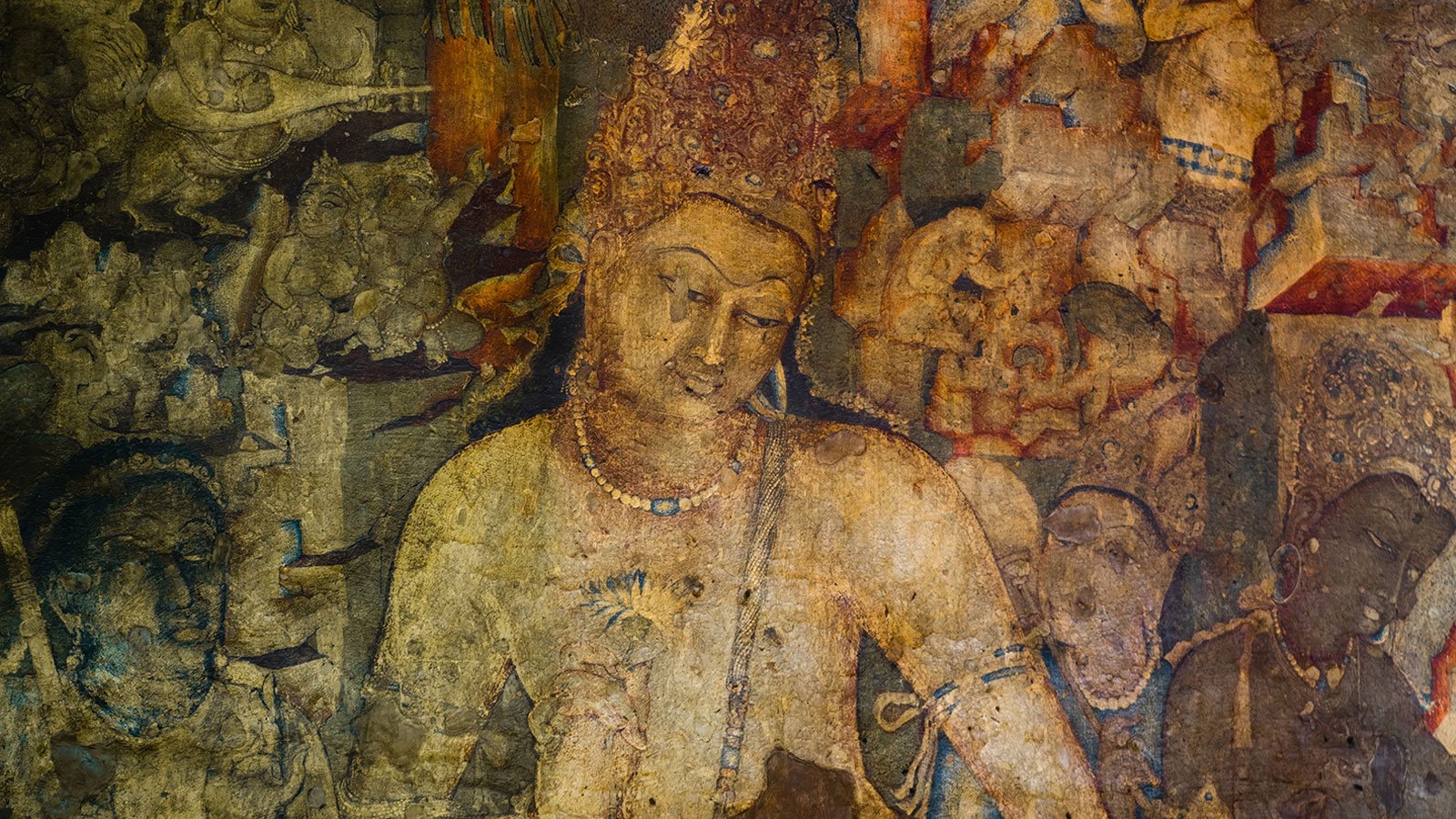
Bodhisattva Padmapāṇi, Cave 1, Ajanta, late fifth century.
Most of us live as though the world simply arrives. A sound reaches the ear, a face comes into view, a memory surfaces, and we meet each one as a plain fact. Around the fourth century, a circle of Buddhist meditators in northern India began asking a quieter question. What if much of what we take as given is shaped, before we ever notice it, by the habits of the mind that receives it? The tradition that grew from that question is called Yogācāra, and it offers one of the most detailed maps of consciousness in contemplative literature.
In This Article
- A Buddhist Map of the Inner Life
- The School of the Yoga Practitioners
- Eight Kinds of Knowing
- Three Ways of Seeing the Same Thing
- Is It All in the Mind
- A Philosophy Born on the Cushion
- The Storehouse in the Treatment Room
A Buddhist Map of the Inner Life
For a healing practice rooted in meditation, Yogācāra rewards patience. Its vocabulary is technical and its debates run deep, but its central insight is intimate. The patterns we carry shape the world we meet, and those patterns can change.
The School of the Yoga Practitioners
The name joins two Sanskrit words, yoga and ācāra, or "practice." Here yoga means meditation and mental cultivation rather than postures, and scholars often suspect the term first described communities of seasoned meditators within mainstream Buddhism.1 The school may also take its name from its foundational treatise, the Yogācārabhūmi, or "Stages of Yoga Practice."1
Readers of our post on the nadis will want to keep a clear line here. Yogācāra is a Mahāyāna Buddhist philosophy. It shares a word with Patañjali's Yoga Sūtras and later haṭha traditions but belongs to a separate lineage with its own texts, questions, and goals.
Tradition credits two half-brothers, Asaṅga and Vasubandhu, with shaping Yogācāra into a distinct school in the fourth to fifth centuries CE.1 Vasubandhu, from Gandhāra in the northwest, was among the most influential thinkers of his era. His concise Yogācāra treatises set the standard for the school, which remained mainstream Buddhist metaphysics in India for roughly five hundred years.2 Both brothers built on scripture, especially the Saṃdhinirmocana Sūtra, "Unraveling the Intent," which presents itself as a third turning of the wheel of the Buddha's teaching.3
The ideas traveled far. The Chinese pilgrim Xuanzang studied in India and carried one line of interpretation home, summarizing ten commentaries on Vasubandhu's Thirty Verses in his Cheng weishi lun.1 Yogācāra became formative for Buddhist thought in China, Japan, and Tibet. This is the same wider Buddhist world that remembered Jīvaka as physician to the Buddha's own community.
Eight Kinds of Knowing
Earlier Buddhist psychology counted six consciousnesses, one for each sense (sight, hearing, smell, taste, and touch) and one for the thinking mind.1 Yogācāra kept all six and added two more that work beneath awareness.
The seventh is kliṣṭamanas, the "afflicted mind." It quietly takes the deeper layers of experience and treats them as a solid, lasting self. Four afflictions color it, namely a false view of self, confusion about self, self-conceit, and self-love. Running continuously, it tints ordinary experience so we habitually feel like separate selves meeting separate objects.1
The eighth is ālayavijñāna, usually translated "storehouse consciousness," and it deserves a closer look.
The Storehouse and Its Seeds
Buddhism teaches that there is no permanent self, and that every experience arises and passes moment by moment. That raises an old problem. If nothing lasts, how do our actions carry forward? How does a habit formed years ago still shape how we react today?
Yogācāra answered with seeds (bīja) and impressions (vāsanā). Every intentional action leaves a trace, a disposition toward future experience, held in the storehouse until conditions ripen it.1 Anger practiced becomes easier to feel. Kindness practiced becomes easier to offer. What we meet in the world arrives already shaped by what we have planted.
Critics charged that the storehouse was simply a self renamed. The Saṃdhinirmocana answered with an image of water. The storehouse is like a river, unbroken in its flow while its waters constantly change.3 Several Yogācāra texts also insist that it ceases entirely at liberation, so it cannot be an eternal soul.1
One detail deserves attention from anyone who works with the body. In the early texts, the storehouse is not a disembodied mind. Its objects include the surrounding world and one's own physical body. It was said to take hold of new life at conception, keep the body alive throughout life, and withdraw at death, leaving the body cold.1
Three Ways of Seeing the Same Thing
Yogācāra also teaches that every phenomenon has three natures (trisvabhāva). The imagined nature is how things appear to an unawakened mind, as fixed subjects meeting fixed objects, neatly sorted by language. The dependent nature is the living flow of experience itself, arising from causes and conditions, especially the ripening seeds. The perfected nature is that same flow seen clearly, free of the imagined overlay.1
The Teaching on the Three Natures, traditionally attributed to Vasubandhu though its authorship is debated, illustrates this with a magician who makes a block of wood appear to an audience as an elephant.4 The elephant is the imagined nature. The conjured appearance, arising from its conditions, is the dependent nature. Seeing that no elephant was ever there is the perfected nature. Nothing needs to be added to reach clarity. Something needs to be seen through.
Is It All in the Mind
Yogācāra is also known as cittamātra, "mind only," and vijñaptimātra, "cognition only." Those labels have fueled a long scholarly argument. Some read the school as ontological idealism, holding that nothing exists outside mind. Others read it as epistemological, claiming only that we never meet anything except through cognition. Still others treat it as a Buddhist phenomenology that sets metaphysical questions aside to describe experience as it is lived.1
Dan Lusthaus, the leading voice for that last reading, argues that "cognition only" was never meant as a celebration of consciousness. It was a diagnosis, an account of the trouble consciousness creates when it projects its own constructions and then clings to them.5 Even scholars who read Yogācāra as idealism note that its mind is not a soul, a divine spirit, or any lasting substance.1
This is where modern wellness language often departs from the classical texts. Phrases such as "your mind creates your reality" or "manifest what you want" borrow the feel of "mind only" while reversing its purpose. For Yogācāra, the mind's world-making is the source of suffering, not a tool for acquiring what we desire. The aim is to stop mistaking our projections for solid things, not to project more skillfully.
A second common conflation equates the storehouse with Carl Jung's collective unconscious, a reading Lusthaus also challenges.5 Resonances exist, but William Waldron's study of the storehouse places it squarely within Indian Buddhist debates about karma, rebirth, and meditation.6 Reading it through Jung risks losing what made it Buddhist.
A Philosophy Born on the Cushion
Scholars disagree about how much of Yogācāra came from meditative experience itself. Lambert Schmithausen traces the storehouse theory to a question raised by deep meditation. If all conscious activity stops in the "absorption into cessation," what keeps the meditator alive, and from where does ordinary awareness return? Robert Sharf and others counter that the role of meditative experience in Buddhist theory is often exaggerated, and that reflection on dreams and illusions drove much of the argument.1
Either way, the tradition names its goal in practical terms. Near their close, Vasubandhu's Thirty Verses describe the "transformation of the basis," a turning at the root of the mind in which the seeds of affliction are uprooted.5 Because afflictions rest in seed form in the deeper layers, the texts argue, their remedies can work on them there.1 Change is possible at the level where the habits live.
The Storehouse in the Treatment Room
Many people know this feeling. "I know this pattern isn't helping me, but I keep falling into it." Yogācāra would not be surprised. Insight at the surface of the mind does not automatically reach the seeds. Patterns planted over years tend to ripen on their own schedule, and the afflicted mind keeps assembling a story of self around them.
This offers a compassionate frame for meditation. Each session of patient attention plants something different. Each moment of seeing a reaction as a reaction, rather than as the truth about the world, loosens the imagined nature's grip a little. Nothing here promises quick results. The storehouse is a river, and rivers change course slowly.
The link to the body calls for care. Yogācāra's storehouse holds the living body as one of its objects, and that resonates with what bodywork teaches, that experience settles into how we breathe, hold, and brace. Still, modern claims about "tissue memory" are not what the classical texts say, and the two should not be merged. The parallel is suggestive, not a proof.
What Yogācāra does offer is a way to hold the whole picture, mind and body, habit and change, without collapsing it into a slogan. The world we meet is shaped by what we carry. What we carry is not fixed.
The storehouse's river image has cousins in the body's own channels, explored in The Living Rivers of Chinese Medicine, and in the Indian medical science traced in Ayurveda and the Knowledge of Life.
Sources
- ↩ Szanyi, S. (2024). "Yogācāra." Stanford Encyclopedia of Philosophy. plato.stanford.edu/entries/yogacara
- ↩ Gold, J. C. (2011, rev. 2022). "Vasubandhu." Stanford Encyclopedia of Philosophy. plato.stanford.edu/entries/vasubandhu
- ↩ Buddhavacana Translation Group, trans. (2020). Unraveling the Intent (Saṃdhinirmocana), Toh 106. 84000: Translating the Words of the Buddha. 84000.co/translation/toh106
- ↩ Gold, J. C. (2006). "No Outside, No Inside: Duality, Reality and Vasubandhu's Illusory Elephant." Asian Philosophy 16(1), 1–38. doi.org/10.1080/09552360500491817
- ↩ Lusthaus, D. (2002). Buddhist Phenomenology: A Philosophical Investigation of Yogācāra Buddhism and the Ch'eng Wei-shih Lun. RoutledgeCurzon. Review at muse.jhu.edu
- ↩ Waldron, W. S. (2003). The Buddhist Unconscious: The Ālaya-vijñāna in the Context of Indian Buddhist Thought. RoutledgeCurzon. doi.org/10.4324/9780203451175