
The Loving One Who Waits, Maitreya Across Buddhist Traditions
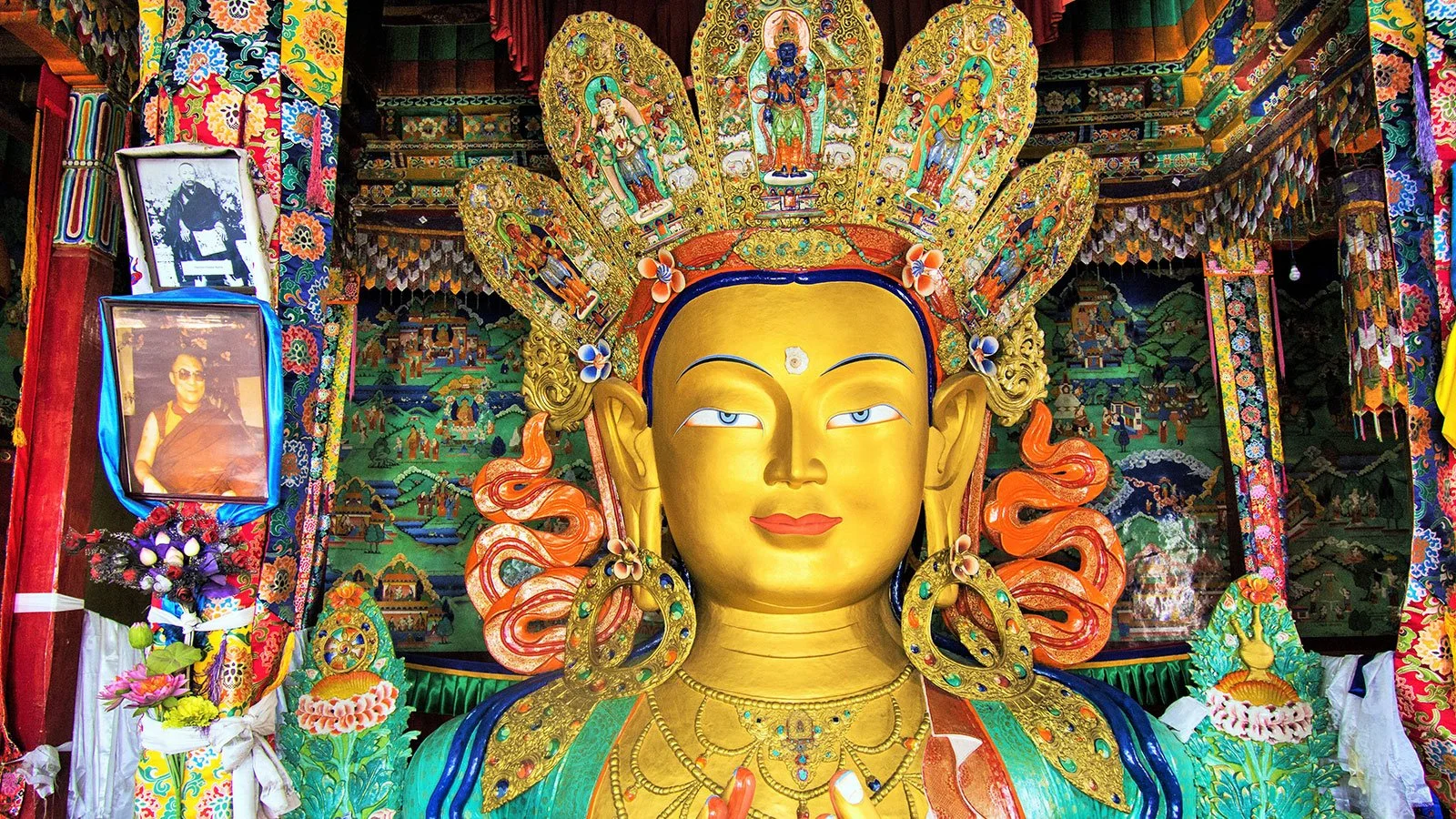
Maitreya Bodhisattva at Thiksey Monastery, Ladakh, India.
Every Buddhist tradition, from the monasteries of Sri Lanka to the temples of Kyoto, agrees on one figure who has not yet arrived. His name is Maitreya (मैत्रेय), often rendered "the Loving One," and he is the Buddha expected to come after Gautama.
Few figures in Buddhism are so widely shared, and few have been imagined in so many ways. He appears as a prophecy in the early discourses, a teacher in a heavenly palace, the source of a major school of philosophy, a pensive prince, a laughing monk, and at times a banner raised for an empire or a revolt. Following him across Asia shows how a single promise takes on the shape of each culture that receives it.
In This Article
- A Single Line of Prophecy
- The Bodhisattva in the Joyful Heaven
- Asaṅga and the Wounded Dog
- The Pensive Bodhisattva of Korea and Japan
- From Imperial Throne to Laughing Monk
- A Modern Lord Maitreya
- Waiting With Open Eyes
A Single Line of Prophecy
We met Maitreya briefly in our post on walking a path of prophecy. He is the earliest bodhisattva to gather a devotional following, and he remains the only one broadly honored in Theravāda Buddhism.1
His name comes from the Sanskrit maitrī, "friendliness," the quality Pali texts call mettā. In Pali he is Metteyya, in Chinese Mile (彌勒), in Japanese Miroku (弥勒), and in Tibetan Jampa (བྱམས་པ), "the Kind" or "the Loving."1
In the Pali discourses he appears in just one place. The Cakkavattisīhanāda Sutta, "The Lion's Roar on the Turning of the Wheel" (DN 26), tells a long and sobering story of moral decline. Lifespans shrink as poverty, theft, and violence spread, until people finally turn back toward restraint and kindness, and the world slowly recovers.
Only at the far end of that recovery does the Buddha announce that another awakened one, named Metteyya, will arise and teach a path as full and pure as his own.2
The setting matters. The discourse does not ask anyone to wait for rescue. Maitreya's coming is the fruit of countless generations choosing to live well, and the Buddha frames the whole story with a plain instruction to his monks, to make themselves an island and the Dhamma their refuge, here and now.2
The Bodhisattva in the Joyful Heaven
Mahāyāna Buddhism raised Maitreya to the rank of the great bodhisattvas, alongside Avalokiteśvara and Mañjuśrī. Its sūtras place him in Tuṣita (तुषित), the "Joyful" heaven, where he serves as Śākyamuni's regent and awaits the right time to take his final birth and restore the Dharma after it has faded from the world.
He is also called Ajita, "the Invincible," and appears often as the Buddha's questioner or as a teacher in his own right.3
Devotion to him took several shapes. Jan Nattier's influential study sorts them by where and when a devotee expects to meet Maitreya.4
Some hoped to be reborn on earth in the distant future, when he descends to teach. Others aspired to rise to Tuṣita after death and hear him teach there now. Still others believed his arrival was imminent, or already underway, a conviction with very different consequences. Each hope shaped practice in its own way, from patient merit-making to fervent expectation.
His images carry this sense of expectancy. Artists show him both as a crowned bodhisattva and as a robed Buddha, often seated with his legs lowered as though ready to rise and step down into the world.1
Asaṅga and the Wounded Dog
Our previous post on Yogācāra closed with Maitreya, because tradition credits him with that school's core teachings. The Five Treatises of Maitreya, which include the Ornament of the Mahāyāna Sūtras and the Analysis of the Lineage (also called the Uttaratantra), are said to have been taught by Maitreya and transmitted by Asaṅga.5
His place in the school reaches back before Asaṅga. In the Saṃdhinirmocana Sūtra (सन्धिनिर्मोचनसूत्र), the scripture at the root of Yogācāra, an entire chapter is given to Maitreya's questions on calm abiding (śamatha) and insight (vipaśyanā), the twin pillars of Buddhist meditation.6 A school named for the practice of yoga found its meditation teaching voiced through him.
Tibetan tradition tells how this came about. Asaṅga withdrew to a cave to meditate on Maitreya, hoping to see him. After years without a sign he left in discouragement, then returned, then left and returned again. After twelve years he gave up for good.
On the way down he found a dog with an open wound crawling with maggots. Moved by compassion for the dog and the maggots alike, he cut flesh from his own body to give the maggots something to feed on and bent to lift them out with his tongue so as not to crush them.
The dog vanished, and Maitreya stood in its place. The bodhisattva told him he had been at Asaṅga's side the entire time, unseen until compassion cleared the way.7
Modern scholarship reads the history differently. Since Erich Frauwallner's work, many scholars have treated the Maitreya of these treatises, sometimes named Maitreyanātha in colophons, as a human teacher of Asaṅga, and many attributions in this literature remain debated.5
Both readings can stand side by side. Whatever its history, the story makes a point a meditator can carry. Twelve years of effort thinned the veil, but compassion is what finally let Asaṅga see.
The Pensive Bodhisattva of Korea and Japan
Some of the most beloved Buddhist sculptures anywhere belong to Maitreya. In Korea and Japan, bodhisattvas shown in the "pensive pose," seated with the right leg crossed over the left knee and the fingertips of the right hand resting lightly against the cheek, are usually identified as Maitreya, known in Korean as Mireuk (미륵).
The most famous is the gilt-bronze figure designated National Treasure 83, made in the Silla kingdom in the late sixth or early seventh century. Maitreya was among the most popular bodhisattvas in East Asia from the fifth through the seventh centuries, and the pensive pose flourished in Korea during that period, shaped by Chinese prototypes.8
A wooden pensive bodhisattva at Kōryū-ji (広隆寺) in Kyoto closely resembles the Korean bronze, and the two are often discussed together.8
These figures hold no drama. The eyes are lowered, the smile is faint, and the whole body seems gathered into a single thought. Applied to Maitreya, the pose suggests a mind turned toward the world's suffering and quietly considering how to meet it. Perhaps that is why they still hold visitors in long silence.
From Imperial Throne to Laughing Monk
In China, the hope of Maitreya's coming took on political weight. In 690, just before Wu Zhao (武曌) was declared emperor of a new Zhou dynasty, a commentary on the Great Cloud Sūtra was presented to the throne.
It quoted a non-canonical apocalyptic scripture in which Maitreya appears amid chaos to defeat demons and rule a renewed world as both teacher and sovereign, and it associated the coming ruler with that savior.9
In later centuries, the expectation that Maitreya was arriving now found a long-lived home among the White Lotus (白蓮教) sects. These lay Buddhist movements took shape from earlier Pure Land devotional societies, and many of their communities came to center on Maitreya's coming.
Daniel Overmyer, whose work remains the standard study, cautions that they were religious communities first rather than simple rebel cells, though some did take up arms, and imperial courts came to treat the name itself as a mark of sedition.10
In the fourteenth century, rebels in the White Lotus orbit invoked Maitreya against Mongol rule during the upheavals that brought the Ming dynasty to power.10
The best-known uprising, the White Lotus Rebellion of 1796 to 1804, broke out in the mountains of central China amid famine, overcrowding, and harassment by local officials. Its leaders promised the return of the Buddha and an end to suffering. The fighting dragged on for nine years and helped hasten the decline of the Qing dynasty.11
In Nattier's terms, these movements expressed the "here and now" form of the myth, and they show how a figure of loving-kindness could become a banner of revolt.4
China also gave Maitreya his gentlest face. Budai (布袋), "Cloth Sack," was a wandering Chan monk of the early tenth century, remembered for his round belly, his ready laugh, and the bag he carried. Chinese Buddhists came to regard him as an incarnation of Maitreya.12
The cheerful figure many Westerners call the "Laughing Buddha" is Budai, not Gautama. In him, the Buddha of the future became an image of contentment in the present.
A Modern Lord Maitreya
In the early twentieth century the name took another turn. The Theosophical Society, a Western esoteric movement, spoke of a "Lord Maitreya," a World Teacher expected to appear through a human vehicle. Its leaders Charles Leadbeater and Annie Besant chose a young South Indian boy, Jiddu Krishnamurti, for that role, and in 1911 they formed the Order of the Star in the East with him at its head.
In 1929 Krishnamurti dissolved the Order, declaring that no organization could lead people to truth.13
This Lord Maitreya sits some distance from the bodhisattva of the sūtras. Theosophy blended a Buddhist name with Hindu, Christian, and esoteric ideas of a returning teacher, and later movements carried that blend forward. Buddhist traditions themselves continue to hold that Maitreya remains in Tuṣita, his descent still ahead.3
Krishnamurti's refusal, oddly, lands closer to the Pali discourse than his would-be followers did. Both point away from waiting on a savior and back toward the work of seeing clearly now.
Waiting With Open Eyes
Across these traditions, Maitreya carries two promises at once. One looks ahead to a teacher who has not yet come. The other is folded into his name. Maitrī, loving-kindness, is not reserved for some distant age. Asaṅga's story places it at the turning point, the moment compassion succeeded where years of striving had not.
The tradition does not ask us to choose between these promises. The one we wait for and the one we practice share a name.
For a meditation practice, this offers a quiet reframe. The texts leave ample room for hope, and the future Buddha still waits in the Joyful heaven. Yet the Pali discourse, the Tibetan legend, and even Krishnamurti's refusal all turn us back toward what can be practiced today.
Loving-kindness meditation, then, is less a technique than a way of preparing the ground for what we hope will arrive. The Silla bronze, fingers resting against its cheek, models the posture well. It is patient, attentive, and ready to stand when the moment comes.
To explore the school of mind that tradition traces to Maitreya's teaching, revisit The Seeds of Experience, or turn to another great bodhisattva figure of the Mahāyāna world in The Medicine Buddha and the Road from Sutra to Clinic.
Sources
- ↩ Gorlinski, V., rev. (2026). "Maitreya." Encyclopaedia Britannica. britannica.com/topic/Maitreya-Buddhism
- ↩ Sujato, Bhikkhu, trans. "The Wheel-Turning Monarch" (Cakkavattisīhanāda Sutta, DN 26). SuttaCentral. suttacentral.net/dn26/en/sujato
- ↩ 84000: Translating the Words of the Buddha. "Maitreya." 84000 Glossary. 84000.co/glossary/41981
- ↩ Nattier, J. (1988). "The Meanings of the Maitreya Myth: A Typological Analysis." In A. Sponberg and H. Hardacre (eds.), Maitreya, the Future Buddha, 23–47. Cambridge University Press. Review at doi.org/10.2307/2057390
- ↩ Szanyi, S. (2024). "Yogācāra." Stanford Encyclopedia of Philosophy. plato.stanford.edu/entries/yogacara
- ↩ Buddhavacana Translation Group, trans. (2020). Unraveling the Intent (Saṃdhinirmocana), Toh 106. 84000: Translating the Words of the Buddha. 84000.co/translation/toh106
- ↩ Himalayan Art Resources. "Asanga, Arya" (Item 358, Tibetan painting with narrative of Asaṅga and Maitreya). himalayanart.org/items/358
- ↩ The Metropolitan Museum of Art. (c. 2013). "A Pensive Treasure." Met Perspectives. metmuseum.org/perspectives/pensive-treasure
- ↩ Hughes, A. D. (2019). "Apocalyptic Saviors, Terrestrial Utopias, and Imperial Authority: The Reign of Empress Wu Zetian (690–705 CE)." Lecture, Fairbank Center for Chinese Studies, Harvard University. fairbank.fas.harvard.edu
- ↩ Overmyer, D. L. (1976). Folk Buddhist Religion: Dissenting Sects in Late Traditional China. Harvard University Press. Review at otani.repo.nii.ac.jp (PDF download)
- ↩ Encyclopaedia Britannica. "White Lotus Rebellion." Encyclopaedia Britannica. britannica.com/print/article/642358
- ↩ Horniman Museum and Gardens. "Figure of Budai Heshang" (Object 1990.79). Collections Online. horniman.ac.uk/object/1990.79
- ↩ Skitt, D. (2007). Faith column on Jiddu Krishnamurti. New Statesman. newstatesman.com/politics/2007/09/krishnamurti-history-world