
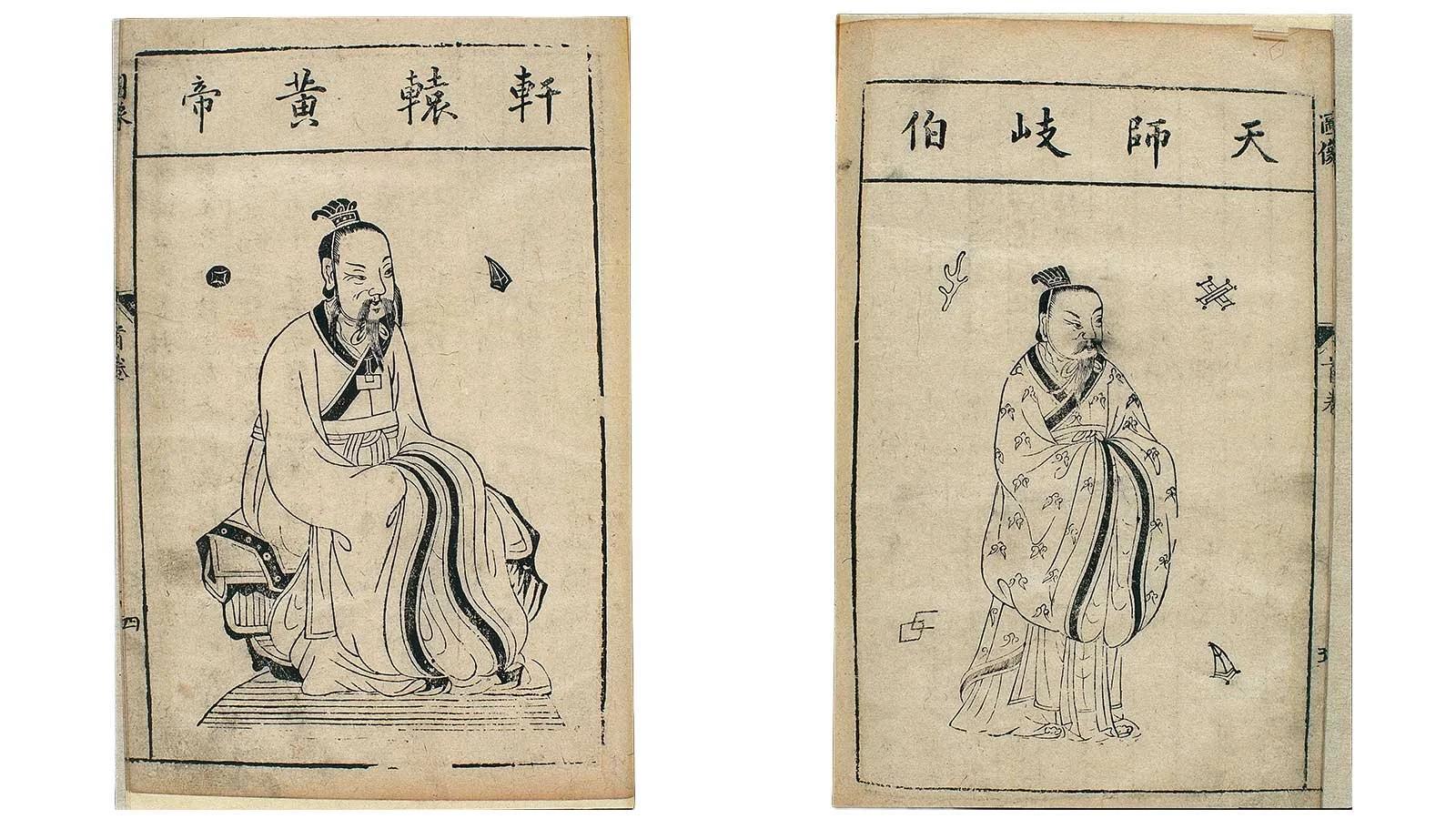
The Yellow Emperor 黃帝 and Qi Bo 岐伯, Ming dynasty woodcuts. Wellcome Collection.*
Long before anyone spoke of “Chinese medicine” as a single system, physicians in China were learning to read the body the way a farmer reads the sky — through change, season, and relationship. What grew from that attention over two thousand years became one of Asia’s great scholarly medical traditions, standing beside Ayurveda, Tibetan Sowa Rigpa, and Greco-Arabic Unani. This is an overview of where it came from, the ideas that hold it together, and how its physicians learned to look, listen, and touch.
In This Article
- From Ancestors to Correspondences
- The Yellow Emperor’s Inner Classic
- Yin, Yang, and the Five Phases
- Qi, Organs, and Channels
- The Four Examinations
- Needle, Fire, and Herb
- Many Rivers, One Name
- Root and Branch
From Ancestors to Correspondences
The earliest Chinese records of illness come from the Shang dynasty, whose kings carved questions into turtle shell and ox bone more than three thousand years ago. When a tooth ached or a dream unsettled the court, diviners asked which ancestor had been offended. Sickness, in that world, was a matter of relationship with the dead.
Over the following centuries, a quieter revolution took shape. Scholars began to explain health through natural patterns — climate, diet, emotion, the turning of the seasons — rather than ancestral displeasure or demonic attack. The historian Paul Unschuld describes this as the point where health care first became medicine in the full sense, grounded in natural law rather than the will of spirits.1
Physical evidence of that shift surfaced in 1973 at Mawangdui (馬王堆), a Han dynasty tomb near Changsha sealed in 168 BCE. Among its silk manuscripts were texts describing eleven vessels running through the body, each linked to its own ailments and treated by cauterization.2 These eleven vessels are widely read as forerunners of the twelve channels in later doctrine.
The details matter. In these two vessel texts, burning was the only therapy, and needling, the treatment most people now link with Chinese medicine, doesn’t appear.2 Donald Harper, who translated the corpus, goes further and cautions against calling this burning “moxibustion” at all, since prepared mugwort tinder isn’t yet attested.3
The Yellow Emperor’s Inner Classic
The text that gathered these threads into a lasting framework is the Huangdi Neijing (黃帝內經), the Yellow Emperor’s Inner Classic. UNESCO, which added a 1339 woodblock edition to its Memory of the World Register in 2011, describes it as the earliest and most important written work of the tradition.4
It comes in two parts. The Suwen (素問), or Basic Questions, lays out theory — yin and yang, the seasons, the origins of disease. The Lingshu (靈樞), or Numinous Pivot, turns toward the channels and the practice of needling.
The Neijing is not the work of one hand. Unschuld traces the Suwen to many short essays written by different authors in the final centuries BCE, later gathered, edited, and expanded. The Tang dynasty scholar Wang Bing added entire chapters on cosmological cycles of climate and qi.1
Most of the text unfolds as conversation. The Yellow Emperor asks, and his advisers, chiefly the physician Qi Bo (岐伯), answer. The emperor himself belongs to myth rather than history, and the stories gathered around him and his consort Leizu deserve a telling of their own.
Yin, Yang, and the Five Phases
Two ideas run through nearly every page. The first is yin and yang — originally the shaded and sunlit slopes of a hill. They name complementary qualities that rise and fall together: rest and activity, cold and heat, interior and exterior. Health is less a fixed state than a living balance between them.
The second is wuxing (五行), usually translated as “five elements.” That translation misleads. Xing means to move or to go, and wood, fire, earth, metal, and water were understood as phases of transformation rather than building blocks of matter. Wood feeds fire, fire leaves ash that becomes earth, and the cycle continues. This is why many scholars prefer “five phases” or “five agents,” the term Unschuld uses.1
Through the five phases, each organ, season, color, flavor, emotion, and direction finds its place in a vast web of correspondence. Spring belongs to wood, wood to the liver, and the liver to anger and the color green. The body becomes a small landscape mirroring the larger one.
Qi, Organs, and Channels
Qi is the animating breath that moves through all things. In the body it circulates with blood, warms and protects, and transforms food and air into vitality. When it flows freely, there is health. When it stagnates, scatters, or runs short, illness follows.
The classics name many kinds of qi. There is the qi drawn from food and air, the protective qi that guards the body’s surface, and the nourishing qi that travels with the blood.
The organs of Chinese medicine are best understood as functional systems rather than anatomical objects. The solid zang organs store, while the hollow fu organs receive and pass along. The classical “spleen” governs the transformation and transport of nourishment, a role with little overlap with the spleen of a modern anatomy text. Reading one through the other is a common source of confusion.
Linking these systems is the network of channels on which the acupuncture points lie. Their history is traced in The Living Rivers of Chinese Medicine. Although often compared to the nadis of yoga, the channels come from a separate lineage, with different texts and different aims.
The Four Examinations
How does a physician read this living web? Classical diagnosis rests on four examinations — looking, listening and smelling (a single word in Chinese), asking, and touching.
Looking takes in complexion, posture, eyes, and especially the tongue, its color, shape, and coating. Listening attends to voice and breath, and smell completes the picture. Asking covers sleep, appetite, thirst, sweat, pain, and the story of how the trouble began. Touching centers on the pulse, felt at both wrists in three positions, each read at different depths.
Pulse reading became an art of its own. In the third century, the physician Wang Shuhe compiled the Pulse Classic (脈經), describing pulse qualities such as floating, sinking, slippery, and wiry that practitioners still learn today.
The aim isn’t only to name a disease but to recognize a pattern — heat or cold, excess or deficiency, interior or exterior — in this particular person. Two people with the same complaint may receive different treatment, while two people with different complaints may receive the same.
Needle, Fire, and Herb
Treatment then follows the pattern. Acupuncture places fine needles at points along the channels, and moxibustion burns dried mugwort on or near the skin to warm them. UNESCO inscribed the pair on its intangible heritage list in 2010, noting they’re still handed down through master and disciple as well as formal schooling.5
Herbal medicine is the other great pillar, and in China it has long been the larger one. The materia medica tradition looks back to Shennong, the mythical Divine Farmer said to have tasted hundreds of plants. It reached a high point with the physician Li Shizhen (李時珍), whose Bencao Gangmu (本草綱目), or Compendium of Materia Medica, was completed in the late sixteenth century. It joined the Neijing on the Memory of the World Register in 2011.6
Prescriptions are rarely single herbs. Classical formulas combine ingredients in balanced, complementary roles, a craft refined in Zhang Zhongjing’s Treatise on Cold Damage near the end of the Han. Massage, diet, therapeutic movement, and the practices of yangsheng, or nourishing life, round out the healer’s tools.
Many Rivers, One Name
The term “Traditional Chinese Medicine,” or TCM, is newer than many assume. For most of its history, Chinese medicine was plural — family lineages, regional practices, and scholar-physicians who argued sharply over how to read the classics. In the early twentieth century, many reformers wanted it abolished altogether.
Historian Kim Taylor has shown how the Chinese Communist Party reversed that course, lifting a sidelined practice into the national health system. Through the 1950s and early 1960s, the state standardized its textbooks, curricula, and theory — what Taylor calls the creation of a “traditional” Chinese medicine.7
None of this makes modern practice inauthentic. It means the clinic you visit today stands on a deliberately unified version of a much older and more varied conversation. Japanese Kampo, Korean medicine, and classical revival movements around the world carry their own branches from the same root.
Root and Branch
The classics speak of ben and biao, the root and the branch. A skilled physician treats the visible branch of a complaint while never losing sight of its root. The same holds for studying the tradition itself. Its branches — needles, herbs, pulses, and correspondences — make the most sense when we follow them back toward their source.
That source runs deeper than medicine. Before the Neijing, there were the wu, China’s ancient spirit mediums, who danced, divined, and healed. Around the Yellow Emperor gathered myths in which shamanism and divination are woven into the art of healing. And behind it all stands the Dao, the way of nature that the physicians were trying to read. Those are the roots this series will follow next.
To follow the channels more closely, continue with The Living Rivers of Chinese Medicine, or step west to compare this tradition with Ayurveda and the Knowledge of Life.
Sources
- ↩ Unschuld, P. U. (2003). Huang Di Nei Jing Su Wen — Nature, Knowledge, Imagery in an Ancient Chinese Medical Text. University of California Press. ucpress.edu
- ↩ Huang, C., Liang, J., Han, L., Liu, J., Yu, M., & Zhao, B. (2017). “Moxibustion in Early Chinese Medicine and Its Relation to the Origin of Meridians — A Study on the Unearthed Literatures.” Evidence-Based Complementary and Alternative Medicine. pmc.ncbi.nlm.nih.gov/articles/PMC5337347
- ↩ Harper, D. J. (1998). Early Chinese Medical Literature — The Mawangdui Medical Manuscripts. Kegan Paul International. Reviewed by L. Raphals. muse.jhu.edu/article/8677
- ↩ UNESCO. “Huang Di Nei Jing (Yellow Emperor’s Inner Canon).” Memory of the World Register, inscribed 2011. en.unesco.org/memoryoftheworld/registry/438
- ↩ UNESCO. “Acupuncture and Moxibustion of Traditional Chinese Medicine.” Representative List of the Intangible Cultural Heritage of Humanity, inscribed 2010. ich.unesco.org
- ↩ Li Shizhen. Ben cao gang mu (Compendium of Materia Medica), 1603 Jiangxi edition. Library of Congress, World Digital Library. loc.gov/item/2021666452
- ↩ Taylor, K. (2005). Chinese Medicine in Early Communist China, 1945–63 — A Medicine of Revolution. RoutledgeCurzon. routledge.com
*Chinese woodcuts, Famous medical figures — The Yellow Emperor and Portrait of Qibo. Gan Bozong (attrib.), from a Wanli-era edition of the Bencao mengquan, 1573–1620. Wellcome Collection. Public Domain Mark. wellcomecollection.org/works/gzz3jzkn and wellcomecollection.org/works/jyqqb9sq